What’s Data Quality Got to Do with AI?
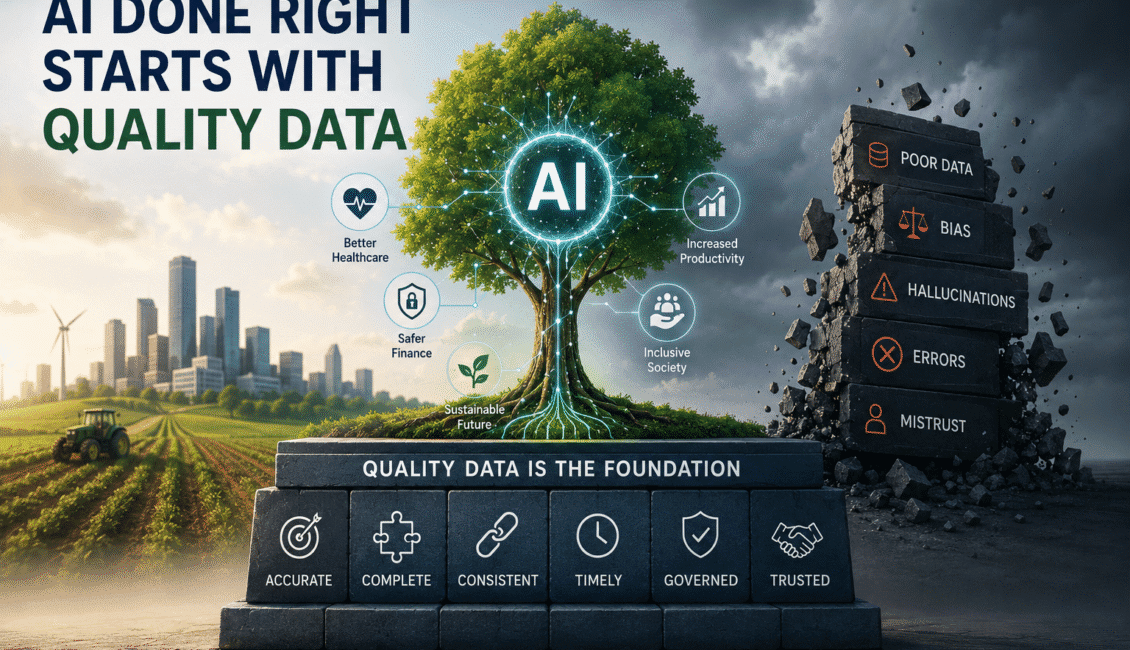
Artificial Intelligence (AI) is being used for good: to develop insights from associations between products that people buy, and, using that, to increase sales. Banks use their algorithms to prevent fraud. The capabilities of AI agents increase productivity through automating operations.
AI is being used to benefit the world at large: for cancer identification and screening, medical diagnosis, prediction of the development of disease; in a mobile app that helps deaf children learn to read by translating the text into sign language, for fighting world hunger by analysing millions of data points to determine crops, develop seeds and maximise output. Done right, AI has huge benefits and potential.
And yet, we also see problems. I’m certain that anyone who has used generative AI, such as ChatGPT and Claude, has experienced the frustration of having them spew out a confident response that is completely or somewhat erroneous. For an unsuspecting user, a response might look and sound right. The response may even include official-looking citations to publications that unfortunately don’t exist. For those who are diligent with fact-checking search results, the glaring mistakes made by AI become increasingly apparent. My concern is that too many people take AI responses as truth with no due diligence. If a response is 80% right and 20% wrong, who are the experts who can tell the difference? Worse, when AI is built into processes invisible to experts, how can we be confident of results?
In one example, research done by the Technical University of Applied Sciences Würzburg-Schweinfurt showed that someone negotiating a base salary as an experienced medical specialist was advised by ChatGPT-o3 for ask for $400,000 if they were male. For the same position, an equally qualified woman was told to ask for $280,000. Yes, AI is quickly changing and improving, but the hallucinations continue. AI done wrong has negative impacts that increase exponentially.
What is to be done? As Tom Redman clearly points out, AI is all about data. Data is part of the input, during processing, as output, and when used. Many dangers from poor-quality data exist within these models that can create serious consequences for companies, consumers, and individuals.
Neither human beings nor machines can make effective decisions with flawed, incomplete, or misleading data. They must have data and information they can trust to be correct and current if they are to do the work that provides products and services and satisfies the organisation’s customers.
We need experts grounded in the fundamentals of how to create and manage high-quality data for all uses – including AI. Danette McGilvray’s Ten Steps Methodology™ provides a solid framework for creating and managing data used to address any business problem, including AI. Achieving the promise and potential of AI, while minimising the risks, can only be done with high-quality data in the forefront. Let’s not miss the promise and potential of AI and the many ways it can improve our organisations, personal lives, and societies because we did not address data quality – this is something we know how to do.
Readers interested in applying these principles can learn more through the Ten Steps to Quality Data course, which equips professionals with proven methods for creating and managing high-quality data that supports effective AI and business decision-making.
Sources:
10 Wonderful Examples Of Using Artificial Intelligence (AI) For Good. June 22, 2020. https://crcs.seas.harvard.edu/news/10-wonderful-examples-using-artificial-intelligence-ai-good.
Bias alert: LLMs suggest women seek lower salaries than men in job interviews news. July 24, 2025
https://www.computerworld.com/article/4028148/bias-alert-llms-suggest-women-seek-lower-salaries-than-men-in-job-interviews.html, Also https://arxiv.org/abs/2506.10491
Thomas C. Redman, PhD. The AI Addendum, March 31, 2026. pgs. 2-3.
Assessment of AI capabilities and the impact on the UK labour market. 28 January 2026. https://www.gov.uk/government/publications/assessment-of-ai-capabilities-and-the-impact-on-the-uk-labour-market/assessment-of-ai-capabilities-and-the-impact-on-the-uk-labour-market
Executing Data Quality Projects: Ten Steps to Quality Data and Trusted Information™, 2nd Ed. (Elsevier/Academic Press, 2021)by Danette McGilvray, See https://shop.elsevier.com/books/executing-data-quality-projects/mcgilvray/978-0-12-818015-0
This article Copyright 2026 by Danette McGilvray, Granite Falls Consulting, Inc. (www.gfalls.com) All rights reserved worldwide.

An internationally respected expert, Danette McGilvray guides leaders and staff as they increase business value through data quality and governance. This data approach benefits focused initiatives (such as security, analytics, digital transformation, artificial intelligence, data science, and compliance) so that high-quality data will support whatever is most important to an organisation, protect its data assets, and help manage risk.
Granite Falls helps connect business strategy with practical steps for addressing specific data quality/governance issues, implementing programs, and improving operational processes.
As president and principal of Granite Falls Consulting, Inc., Danette is committed to the appropriate and effective use of technology and also to addressing the human aspect of data management through communication and change management. See www.gfalls.com.
Danette is the author of Executing Data Quality Projects: Ten Steps to Quality Data and Trusted Information, 2nd Ed. (Elsevier/Academic Press, 2021), which shares a proven method used successfully by multiple industries in many countries. Her book is often described as a “classic” or noted as one of the “top ten” data management books in social media conversations. The book is used in university graduate programs and has been translated into Chinese and Japanese. The Spanish translation is currently underway.
Danette is a co-author of “The Leader’s Data Manifesto”, a document used to raise awareness about treating data as a business asset. She has overseen its translation into 24 languages. See www.dataleaders.org.