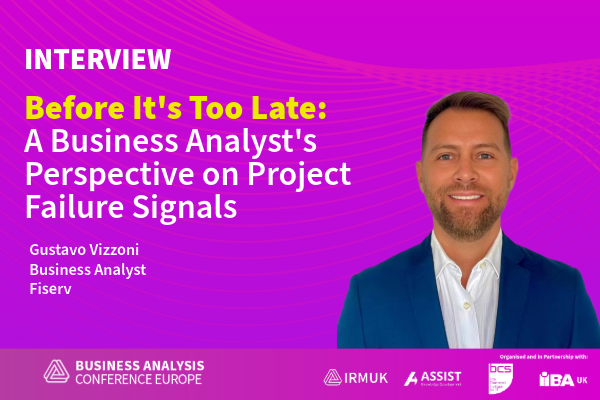
Before It’s Too Late: A Business Analyst’s Perspective on Project Failure Signals
Projects rarely fail overnight. More often, project failure signals appear long before deadlines slip, budgets escalate, or stakeholders raise concerns. The challenge is recognising them before it’s too late.
Ahead of his session, Signals of Project Failure Business Analysts Must Recognise … Before It’s Too Late!, we spoke with Gustavo Vizzoni, Business Analyst at Fiserv, about the subtle indicators that projects are drifting off course, why organisational misalignment often goes unnoticed, and the critical role Business Analysts play in identifying risk before it impacts delivery.
In this interview, Gustavo shares practical insights from his experience in banking and fintech, revealing the patterns, behaviours and stakeholder dynamics that can signal trouble long before they appear in a status report.
Q1: What made you want to tackle this topic at BA2026?
Honestly, it started from observation. Across different transformation programmes in banking and fintech, I noticed a pattern that kept repeating, not in every project, but often enough to feel significant. Projects showing all the right signs of progress on paper, while the real problems were already forming underneath.
Detecting those signals early is not something that immediately sounds like a BA responsibility. But when you think about it, we are the role closest to both the business context and the details of what is actually being built. We sit in the conversations, we read the requirements, and we see how stakeholders engage or stop engaging. That puts us in a unique position to notice things before they become visible to everyone else.
So the topic felt important and, honestly, a little underexplored. I wanted to bring it to a senior BA audience because I think we sometimes underestimate the diagnostic value of our own role.
Q2: What’s one subtle signal Business Analysts often overlook in transformation initiatives?
Silence.
Not the obvious kind, missed deadlines or unanswered emails. I mean the quieter version. A stakeholder who joins every call but never really contributes. Someone who takes longer than usual to respond, and when they do, the answer feels vague or noncommittal. A subject matter expert who was engaged at the start and is now just… present.
The instinct is to explain it away. It’s bureaucracy, a busy period, maybe they didn’t fully understand the question. And sometimes that’s true. But sometimes that silence means something else entirely, that the person is losing interest, reconsidering their position, or already exploring other directions they haven’t shared with the team yet.
We operate in an environment of constant negotiation. Stakeholders are always weighing priorities, managing their own pressures, and making decisions that don’t always surface in the official project conversation. When someone goes quiet, it’s worth asking why, because by the time the disengagement becomes visible to everyone, you’ve usually already lost weeks.
The BA is often the first person in a position to notice that shift. But only if they’re paying attention to the right patterns. And stakeholder silence is just one of them. There are others, some hidden in the requirements themselves, others in how decisions get made across the organisation.
Q3: Why do you think organisational misalignment can be so difficult to spot early on?
Because on the surface, everything looks like it’s working. There are workshops, there are meetings, there are sign-offs. The process is running.
But what’s harder to see is what’s happening underneath. People who haven’t found the right moment to speak up, so they stay quiet. And silence, when it repeats often enough, turns into something else, frustration, disengagement, a quiet decision to wait and see how things unfold rather than actively contribute.
That’s a form of misalignment that doesn’t appear in any status report.
There’s another dimension to this. The people who have the most to gain from a project succeeding, the ones who genuinely care about the outcome, need to be active and visible in the room. When they’re not, when workshops are filled with people going through the motions, you lose the internal energy that keeps alignment real. And without that, even a well-structured project can drift.
The BA’s job, in part, is to make sure the right people are genuinely in the room, not just listed on the invite.
Q4: In fast-moving delivery environments, are organisations becoming better or worse at recognising project risk?
Worse. At least that’s what I observe, particularly in fintech.
Not because people lack the skills or the awareness. But because the incentives are pointing in the wrong direction. The pressure is to deliver fast, to tick the boxes, to close things out. And in that environment, asking uncomfortable questions starts to feel like an obstacle rather than a contribution.
There’s also something happening with how documentation and reporting are being produced. With AI tools accelerating output, it’s easier than ever to generate content that looks thorough, that fills every required field and follows every template. But volume is not the same as quality. A requirements document that checks all the boxes is not the same as one that has been genuinely challenged and validated.
The result is a culture that is increasingly good at the appearance of progress, and increasingly reluctant to slow down long enough to question it.
That’s precisely where the BA role becomes more important, not less. Someone has to be willing to ask the question that closes the meeting later but saves the project.
Q5: What kinds of challenges or situations inspired the stories and insights you’ll be sharing?
Several situations over the years, but one stands out.
A client engagement where the indicators were there, we just weren’t reading them clearly enough at the time. The documents were progressing, the status was green, and meetings were happening. But something felt off. Responses were taking longer. Stakeholders who had been engaged at the start were becoming harder to reach. The energy had shifted, even if nothing in the reporting reflected that.
Eventually, the client changed direction entirely. And while it felt sudden, looking back, the signs had been building for a while.
What that experience gave me was a much sharper diagnostic instinct. I started paying closer attention to what wasn’t being said, the delayed responses, the quieter voices, the meetings where everything was agreed but nothing felt truly owned. And I realised that with earlier, more deliberate engagement, there were conversations that could have happened. Alternatives that could have been explored. Outcomes that might have looked very different.
That’s really where this session comes from, not from theory, but from understanding what becomes possible when you catch those patterns early enough to act on them.
Q6: What role do you believe Business Analysts should play when they sense a project may be drifting off track?
To say something, clearly, and early.
When a BA senses drift, the first responsibility is to name it with the precision that comes from having observed the warning signs. A stakeholder who has gone quiet, requirements that keep getting deferred, and decisions being made locally that don’t connect to the broader objective.
But beyond identifying the problem, the BA has an active role in creating the conditions for re-engagement. That means finding the right moments to have the conversations that aren’t happening, a one-to-one before a workshop, a direct question that opens a door, a deliberate check-in with someone who has been present but not really there. It means looking for opportunities, not waiting for them.
Sometimes it’s about how you ask, not just what you ask. Framing a question differently, choosing a less formal setting, finding the moment when a stakeholder is more likely to speak honestly, these are real skills, and they matter.
The BA is often the person with the clearest view across both the business context and the delivery detail. That position comes with a responsibility to stay close to the people, not just the process, and to keep creating the openings that allow problems to surface before they become decisions that are already too late to influence.
Q7: What are you most looking forward to discussing with attendees at Business Analysis Conference Europe 2026?
Honestly, the conversations after the session.
The formal presentation gives me twenty minutes to share a perspective built from real experience. But what I’m really looking forward to is hearing from the people in the room, the patterns they’ve recognised in their own projects, the moments where they sensed something was wrong but weren’t sure how to act on it, or the times they did act early enough to make a difference.
I think there’s something powerful about being in a room with senior BAs from different sectors and cultures. Everyone has lived through a version of these situations, and the details are always different, the industry, the organisation, the stakeholders involved. But the underlying patterns tend to be surprisingly similar. Those are the conversations I find most valuable.
I’m also speaking at this conference for the first time, and that in itself feels significant. Being part of an international community of practitioners who take this craft seriously. That’s something I genuinely look forward to. I hope to leave with as much as I bring.
Join Gustavo at BA2026
From stakeholder silence and disengagement to hidden organisational misalignment, Gustavo’s session explores the early warning signals that Business Analysts are uniquely positioned to detect.
If you’re involved in change, transformation or delivery initiatives, this practical session will help you sharpen your diagnostic skills, ask better questions and recognise project drift before it impacts outcomes.
Signals of Project Failure Business Analysts Must Recognise … Before It’s Too Late!
📅 Monday 21 September 2026 | 11:35am – 11:55am
📍 Business Analysis Conference Europe 2026, London
Join Gustavo and discover how Business Analysts can move beyond documenting requirements to become one of the most valuable early-warning systems in any transformation programme.