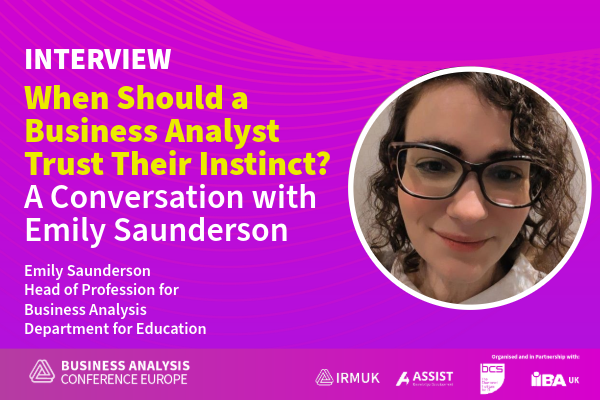
When Should a Business Analyst Trust Their Instinct? A Conversation with Emily Saunderson
Every experienced Business Analyst knows the feeling. Something about a project, decision or stakeholder conversation doesn’t quite add up. You may not have the evidence yet. You may struggle to explain exactly why. But your experience is telling you to pay attention.
So, when should a Business Analyst trust their gut, and when should they rely on the tools, techniques and evidence in front of them?
Ahead of the Business Analysis Conference Europe 2026, we caught up with Emily Saunderson, Head of Profession for Business Analysis at the Department for Education, to explore the thinking behind her session, Trusting Your BA Gut.
Drawing on nearly two decades of experience across cybersecurity, defence and the public sector, Emily discusses why BAs sometimes second-guess themselves, the importance of speaking up when something doesn’t feel right, and how confidence, experience and intuition can work alongside disciplined analysis.
She also shares her thoughts on what this means in an age of AI, where the ability to question, challenge and apply human judgement may become more important than ever.
1. Your session explores the idea of “trusting your BA gut”. What inspired you to choose this topic for BA2026?
As a BA leader, I spend a significant amount of time reflecting on my practice and how it has developed over time. Sometimes that means replaying the bits that didn’t go so well, and asking myself “if I could go back in time – what would I have done differently?” This topic came out of one of those reflections, and how my confidence and ability to be more decisive have grown through experience. I also mentor BAs in various career stages who struggle to get across to stakeholders what needs paying attention to, and usually it’s got nothing to do with tools or techniques, but it’s getting the BA to realise they already know the right answers, they just need to “trust their own gut” and be stronger in their persuasiveness
2. Most Business Analysts have experienced that feeling when something doesn’t seem quite right. Why do you think we sometimes ignore our instincts, even when experience is telling us otherwise?
Yes, absolutely. The BA role is an incredibly difficult balance of using thorough and rigorous techniques to draw out data as clear evidence for decision making, but also carefully navigating building great relationships with stakeholders. We know that one wrong word or one small error could risk any positive buy in, so we naturally second guess ourselves and do whatever we can not to lose trust. However, it really is our responsibility to say the unpopular thing that needs to be heard, even if that puts us in a risky position.
3. Without giving too much away, what’s one common situation where a BA’s intuition can be just as valuable as data or process?
There are so many of these situations, I think perhaps anyone would recognise them. The meeting with too many loud opinions, the workshop where everyone is an expert in their part of the business but no one has expertise in the whole, the team without the right oversight or the visionary leader who hasn’t been part of a direct delivery in a little longer than is comfortable. None of these situations definitely lead to trouble, but the indicators are there that they could.
4. Your session talks about balancing instinct with discipline. How can Business Analysts build the confidence to speak up when they don’t yet have all the evidence?
Practice in safety, bounce your ideas off peers, prepare a good argument, high-quality storytelling – there are so many ways to test the waters before causing a splash (or a hurricane!). I don’t want to give too many spoilers, but I’d invite any BA to not just ask the five whys, but also conversely and sometimes also perversely ask the five (or more) why nots too – find every way possible to take small, palatable risks.
5. You’ve led Business Analysis across defence, cybersecurity and the public sector. Have there been moments in your own career where trusting your instincts made a real difference?
I have to be careful how I answer this, but often it’s about picking up on intel to stop something happening rather than to make things progress. I like to check in with people I work with (and care about) as often as I can. I got a sense that things were starting to get difficult in one of my previous project teams, so I reached out to someone I used to speak to daily, who I knew was shortly about to leave the project due to changes outside of both of our control. My intuition had not necessarily prepared me for what turned out to be a very lengthy let it all out moment, but there was a small snippet in what I was told I knew I couldn’t keep to myself – and I very carefully and quietly escalated something which could have made a serious negative impact to the cost of the work. I’m not suggesting breaking confidences, but for this one, I felt obligated.
6. Business Analysis is evolving rapidly alongside AI, new ways of working and increasing organisational complexity. Do you think intuition is becoming more important or less important for modern Business Analysts?
I caught a recent news article about a groundbreaking surgery performed on conjoined twins, and the surgeon referred to the team as “organic intelligence” and impressed on the person interviewing him about working in partnership with the artificial intelligence. I wholeheartedly support this view, and I think as AI is embedded into everything we do, learning how to remain instinctual when it feels like we can delegate a lot of the more tedious sides of job to AI is going to be more important than ever. If we work well with AI, we can always find the evidence to support what we are trying to achieve, but if we miss the hallucinations and accept them, it harms our work and our profession.
7. What are you most looking forward to discussing with attendees at Business Analysis Conference Europe 2026?
Is it cringey to say….Business Analysis? Meeting and spending time with other BAs really does fill me with joy; we’re a brilliantly diverse community with some core beliefs in common. In a divided world, finding commonality with other brilliant people for no specific reason other than we always believe we can make something a little better and however limited our reach is, we absolutely can achieve that; it’s truly special.
Join Emily at BA2026
Great Business Analysis isn’t only about having the right framework, asking the right questions or producing the right evidence.
Sometimes, it’s recognising a pattern before you can fully explain it. It’s having the confidence to challenge the direction of travel. And it’s knowing when your experience is telling you that something deserves a closer look.
In Trusting Your BA Gut, Emily Saunderson, Head of Profession for Business Analysis at the Department for Education, will explore how Business Analysts can develop greater confidence in their professional instincts while balancing intuition with evidence and discipline.
If you’ve ever sat in a meeting thinking “something isn’t right here” but weren’t sure whether to speak up, this is a session you’ll want on your agenda.
Trusting Your BA Gut
📅 Tuesday 22 September 2026 | 10:25am–11:10am
📍 Business Analysis Conference Europe 2026, London
Join Emily to explore what happens when Business Analysts learn the rules, understand the evidence and develop the confidence to trust themselves when it matters.