The Hidden Cognitive Cost of Meetings: Why Neurodivergent Brains Pay Double
Emily King, Business Analyst, Novuna
We talk a lot about the time cost of meetings, but we almost never talk about the cognitive cost. The mental energy required to prepare for, recover from, and act on a meeting. And if you’re neurodivergent? Congratulations. You’re paying double.
As a neurodivergent Business Analyst, I’ve learned that a “30-minute meeting” is never 30 minutes. It’s a whole cognitive saga with multiple chapters, each one draining in its own special way.
Let’s walk through the real lifecycle of a meeting, and why neurodivergent brains get absolutely rinsed by it.
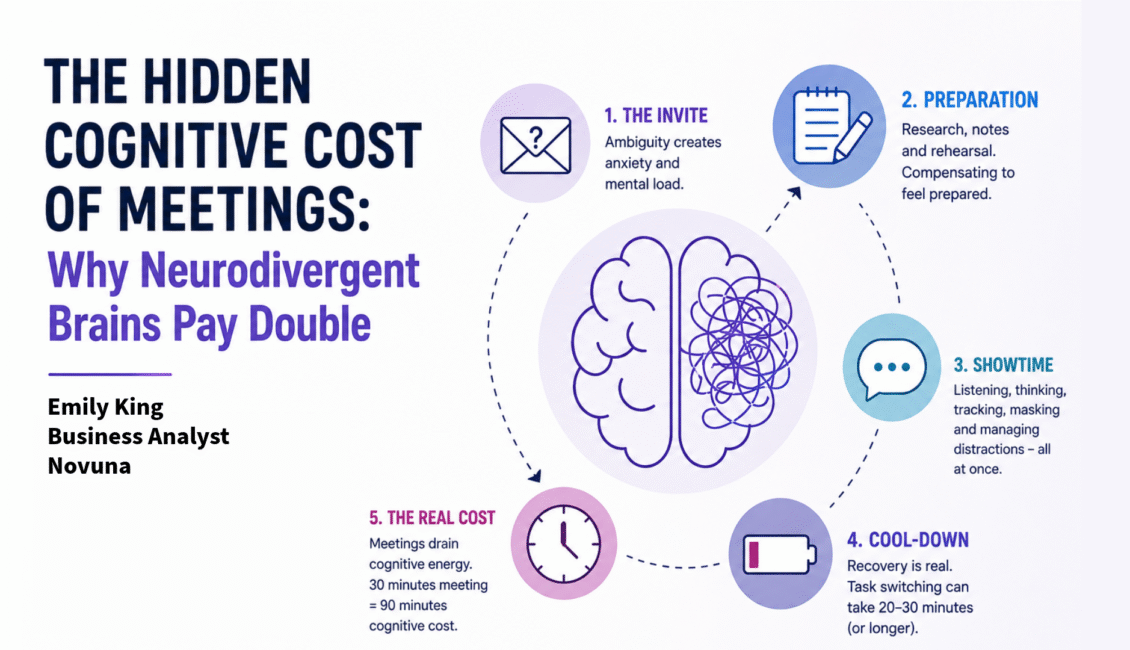
1. The Mystery Meeting Invite
You know the one: “Catch Up”. No agenda. No context. No clue what you are walking into.
Cognitive load theory (Sweller, 1988) tells us ambiguity increases mental effort because your brain has to fill in the gaps. Neurodivergent brains hate gaps. We need clarity, structure, and ideally a small novel explaining what the meeting is about.
A vague meeting invite can trigger pre-meeting anxiety, over-preparation, and a fear of being blindsided.
Before the meeting even starts, you’ve worn yourself out.
2. The Preparation Phase
Preparation for neurotypicals: skim the document, show up.
Preparation for neurodivergents: a full pre-meeting research binge.
Mine looks like:
- Attempting to read everything that has ever been written about the topic
- Making extensive notes and writing scripts
- Mentally simulating the meeting and rehearsing what I might say
This isn’t overthinking, it’s compensating for working memory differences. Preparation becomes a survival strategy.
And this is where the cognitive cost multiplies: last minute rescheduled meetings. All that prep has an expiry date.
These are the meetings that slide down your calendar like a melting ice cube.
You prepare on Tuesday.
You prepare on Thursday.
And now it’s been pushed to first thing Monday morning, where it has found a cosy spot nestled neatly between all those other Monday morning meetings.
Cue the internal spiral:
- Do I log on early on Monday to prepare for this again?
- There’s no way I’ll remember what this was about after the weekend.
- What if the earlier meeting over runs?
- What if this meeting over runs?
- There’s no prep or recovery time
By the time the meeting finally happens, a neurotypical could deliver a keynote speech on the topic. Me, however? I’m exhausted and frustrated because I’ve spent three times the cognitive energy.
3. Showtime
The meeting starts, and suddenly my brain is doing twelve things at once.
Self-monitoring and masking: “What is my face doing?” “Do I look engaged?”, “Am I staring too much?”, “Am I staring enough?”
Internal panic: “Have I said enough?” “Did I say something stupid?”
Cognitive juggling: Listening, reading the chat, reading documentation whilst someone shares their screen and scrolls up and down, up and down. I’m writing notes, tracking decisions and actions, and desperately trying to keep hold of the one thing I wanted to say, waiting for a tiny gap in the discussion.
Distraction management: Fifteen unread Teams messages and three emails appear mid-meeting. My brain notices them, but I know myself too well to risk looking at any of them.
Snack dilemma (in-person meetings): “Should I take a snack?”. “If I take a snack, will I look weird?”, “What if the wrapper is loud?”, “What if my stomach rumbles?”
A neurotypical working memory can hold around 3-5 items at once.
Meetings demand 10-12 simultaneous cognitive tasks.
Processing challenges and masking add an extra thread too: “Don’t be weird… don’t be weird”
And then the part nobody talks about, the moment the Teams call ends and I let out the biggest sigh known to mankind.
Not a polite exhale.
A full body, “my soul has left me” sigh.
Because the meeting itself isn’t just listening. It’s everything all at once.
4. The Cool-Down
The meeting ends, the mask slips, the shoulders drop, the face relaxes, and the performance ends.
This is where Meeting Recovery Syndrome kicks in. This is the time your brain needs to mentally reset after a meeting. And yes, it’s a real thing.
The American Psychological Association reports that task switching can reduce productivity by up to 40%.
That’s for neurotypical brains.
For neurodivergent brains? Add monotropism, the theory that neurodivergent people often operate in deep, single-track focus, and the cost skyrockets.
When a meeting interrupts your work, your mental model collapses, your clarity evaporates, and your momentum dies. Switching back afterwards can take 20-30 minutes. Sometimes longer.
This is why “quick catch-ups” are the enemy of productivity.
A 30 minute meeting becomes a 90 minute cognitive event.
Recovery looks different for everyone, but it matters for everyone.
If you’re lucky enough to not jump straight into another meeting, recovery might look like:
- Rewriting your notes
- Replaying the parts you zoned out on
- Calming sensory overload by moving, stretching, or making a cuppa
- Rebuilding the mental model of the task you were focused on before the meeting
A day of back-to-back meetings leaves me in a state of shock where you’ll find me non-verbal, staring at a wall.
What inclusive meeting design actually looks like
Start with the most important question: Does this need to be a meeting?
If it does, reduce the cognitive cost by:
- Providing clear agendas, outcomes, and background materials in advance
- Sharing written summaries afterwards
- Inviting fewer attendees
- Allowing time to think before answering
- Creating opportunities for everyone to contribute, rather than relying on people finding a gap to speak
- Making cameras optional
- Reducing small talk pressure
- Not trying to squeeze too much in
- Avoiding “quick calls” that interrupt deep work
- And if it’s in person – snacks
These are not neurodivergent accommodations, they’re good practices for everyone.
My Final Thought for Neurodivergents
If meetings drain you, it’s not because you’re not capable. It’s because meetings are cognitively expensive, and neurodivergent brains pay more.
Turn the camera off, relax your face, let it react however it wants to those ridiculous comments, and eat the snack.
Join Emily at BA2026
Meetings are just one example of how everyday ways of working can create hidden barriers for neurodivergent people.
At the Business Analysis Conference Europe 2026, Emily King, Business Analyst at Novuna, will take the conversation further in Beyond “One-Size-Fits-All”: Creating a Neuro-Inclusive Culture.
Drawing on her lived experience as a neurodivergent Business Analyst, Emily will explore how common BA practices can unintentionally limit different thinking styles and what we can do differently.
From designing more neuro-inclusive workshops and making communication more accessible to recognising hidden barriers in everyday BA activities, the session will offer practical adjustments that can support neurodivergent BAs and stakeholders while creating better experiences for everyone.
Beyond “One-Size-Fits-All”: Creating a Neuro-Inclusive Culture
📅 Tuesday 22 September 2026 | 11:20am – 12:05pm
📍 Business Analysis Conference Europe 2026, London
Join Emily and discover how small changes to the way we communicate, collaborate and facilitate can help create a more neuro-inclusive Business Analysis culture.