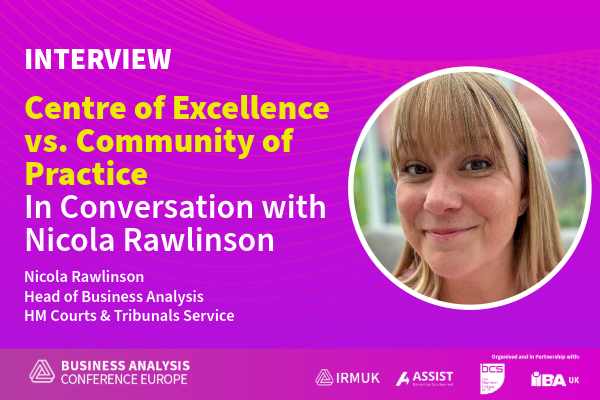
Centre of Excellence vs. Community of Practice – In Conversation with Nicola Rawlinson
What does it take to build a Business Analysis profession where people feel supported, empowered and able to grow?
Centres of Excellence and Communities of Practice are often discussed within organisations, and sometimes the terms are used interchangeably. But are they really the same thing? And does an organisation need to choose between them?
Ahead of the Business Analysis Conference Europe 2026, we caught up with Nicola Rawlinson, Head of Business Analysis at HM Courts & Tribunals Service, to explore the thinking behind her upcoming session, Centre of Excellence vs. Community of Practice – Stand Alone or Stand Together?!
Drawing on her experience of developing the BA profession within HMCTS, Nicola discusses what she has learned about creating spaces where Business Analysts can share ideas, develop their capabilities and support one another. She also reflects on leadership, adapting to change and why professional communities could become even more valuable as AI continues to reshape the way Business Analysts work.
1. Your session explores two concepts that are often mentioned together but not always fully understood. What inspired you to explore this topic for Business Analysis Conference Europe 2026?
The short answer is personal experience.
I joined HM Courts & Tribunals Service just as the Centre of Excellence idea was being introduced, but in practice we kept switching between “Centre of Excellence” and “Community of Practice” when setting up meetings and talking about the profession. I hadn’t worked with either model before joining HMCTS, so as I became more involved in leading the profession, I wanted to properly understand what the difference was and whether the distinction actually mattered.
2. Having worked in both the private and public sectors, what differences have you noticed in how Business Analysis professions are supported and developed?
I’m not sure the differences are really sector specific. I know people in the private sector who work within strong BA professions. But in my own experience, the BAs I worked with in private sector organisations tended to be more part of a project team than part of a wider BA team or profession. I hadn’t come across Communities of Practice or profession-specific Centres of Excellence before moving into the public sector nearly five years ago. That said, it may also be a timing thing, because organisations across both sectors now seem to be recognising the value of peer support, shared standards and professional communities much more.
3. As Head of Business Analysis at HM Courts & Tribunals Service, what has been the biggest lesson you’ve learned about building a strong BA profession?
The biggest lesson for me is that Business Analysts have brilliant ideas and if you create the space for people to share them and try things out, it makes a real difference. First, people feel empowered and safe to experiment, which helps them develop themselves and can also move the whole profession forward. Second, it builds trust across the team, so peer support, engagement and collaboration all grow naturally.
4. You describe yourself as both a leader and a practising Business Analyst. How does balancing those two perspectives influence your approach?
I think leading in an area I’ve worked in myself gives me a much deeper understanding of the challenges a BA team can face. I’ve worked at different levels, on different types of projects and with different methodologies, so I can often relate to the situations the people I lead are dealing with because I’ve lived through similar ones myself.
It also gives me the knowledge and confidence to truly champion the BA profession, both internally and externally.
5. Looking at the profession more broadly, what do you think Business Analysis teams need most to help them thrive in today’s organisations?
It has to be the ability to adapt.
BAs are usually very good at adapting, and in today’s organisations priorities, direction and budgets can change quickly. We need to be able to roll with those changes while still helping teams make good decisions. And as more technology is introduced into the role, we need to use it well, so we stay relevant but without losing the human connection that sits at the heart of good business analysis. That makes continuous personal development more important than ever.
6. As AI and digital transformation continue to reshape the profession, how do you see the role of Business Analysis communities evolving over the next few years?
I think the superpower of professional communities currently is the way they share knowledge and real experience. With things like AI changing so quickly, it’s incredibly valuable to hear from people who have actually tried new tools or new ways of working and can share what worked, what didn’t and what they learned. I think capability building and peer support will become even more important, along with making sure digitally influenced ways of working are reflected in our standards and service offer.
7. Without giving too much away, why should attendees make time for your session?
Because I’m very entertaining!
More seriously, I hope the session will help people cut through some of the terminology and think about what their BA profession actually needs. Whether people are working with a Community of Practice, a Centre of Excellence or something that sits somewhere between the two, the important thing is being clear about the purpose, the value and how it helps people do their best work.
Join Nicola at BA2026
Building a strong Business Analysis profession isn’t simply about choosing between a Centre of Excellence and a Community of Practice. It’s about understanding what your BAs need, creating opportunities to share knowledge and building an environment where people can develop, collaborate and do their best work.
In Centre of Excellence vs. Community of Practice – Stand Alone or Stand Together?!, Nicola Rawlinson will share her experience of developing both approaches within HM Courts & Tribunals Service, including the benefits, challenges and lessons learned along the way.
If you’re responsible for developing a BA capability, leading a Business Analysis team or simply want to strengthen the BA community within your organisation, this session will offer plenty of practical insight to take back to your workplace.
Centre of Excellence vs. Community of Practice – Stand Alone or Stand Together?!
📅 Tuesday 22 September 2026 | 11:20am – 12:05pm
📍 Business Analysis Conference Europe 2026, London
Join Nicola and discover how greater clarity around purpose, value and professional support can help build a stronger Business Analysis profession.