From Generative AI to Agentic AI
Artificial Intelligence is evolving rapidly, and the role of the Business Analyst is evolving with it. In this article, Kitty Hung, Book, Author / Technology Advisor, Independent / ShenWoman, examines the shift from Generative AI to Agentic AI, exploring how Business Analysts can move beyond using AI tools to become architects of AI-driven transformation, governance and innovation.
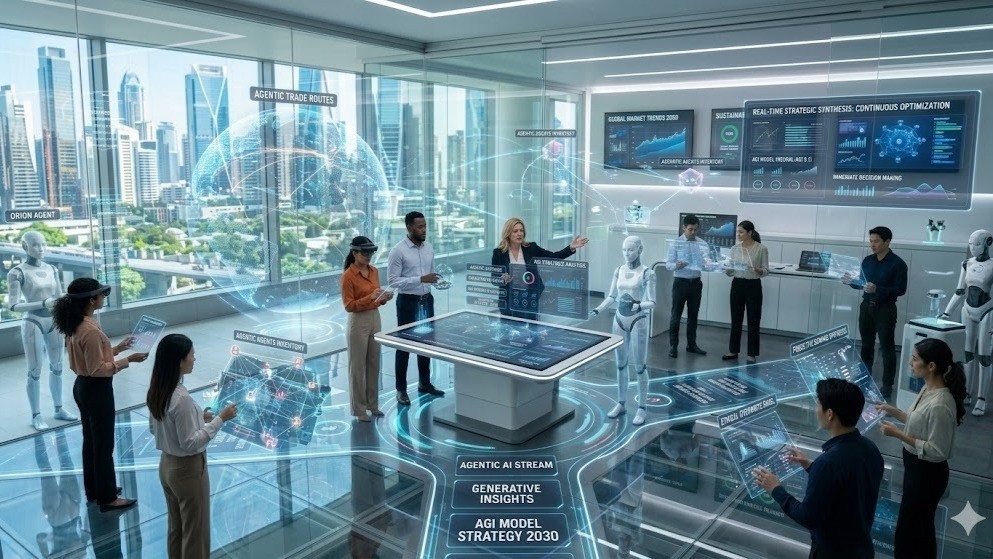
The business analysis profession is entering a transformative era of modernisation, transitioning from the use of passive generative tools to the sophisticated orchestration of active agentic systems (just look how Open Claw has taken the world by storm since February 2026). While Generative AI focuses on a linear “Prompt -> Response” model to execute one-time instructions, the future of the industry lies in Agentic AI, which is an autonomous system capable of making decisions and planning through a continuous loop of Goal, Plan, Execute, and Evaluate.
From a Generative AI User to An Agentic AI Orchestrator
The landscape from a Generative AI user to an Agentic AI Orchestrator is not just changing, it is fundamentally restructuring itself. And to do that effectively, Business Analysts (BAs) really need to focus on hard and actionable architectural frameworks. Knowledge in this domain is only valuable when it is rigorously applied. In the current tech climate, understanding the mechanics of this shift is basically the only viable strategy for BAs to remain indispensable to their employers/organisations.
Transition from a Passive User to an Active Orchestrator
The below table shows the comparison between a passive Generative AI user and an active Agentic AI Orchestrator:

The most fundamental shift in the profession is moving beyond the “Passive User” model of Generative AI. While traditional AI relies on a linear “Prompt -> Response” interaction trapped within a chat window, the future belongs to Agentic AI. In this new role, BAs act as an “Orchestrator” who defines high-level goals and constraints rather than executing manual, granular tasks.
Mastering the “Agentic Loop” and Multi-Agent Governance
BAs must understand the mechanics of the “Agentic Loop” which is a continuous cycle of Goal, Plan, Execute, and Evaluate. Instead of a monolithic system, the objective is to manage collaborative “swarms” of specialised agents, such as Data Gatherers, Modellers, and Polarisers. Successful orchestration requires managing five critical architectural layers:
· Layer 1: Agent Identification and Authority.
· Layer 2: Task Decomposition and Contracts.
· Layer 3: Communication Protocols.
· Layer 4: Control, Review, and Escalation (including “tripwires” for human intervention).
· Layer 5: Memory and Persistence Rules.
The Orchestrator’s Blueprint
The Orchestrator’s Blueprint is a framework designed to help BAs move up the chain of abstraction as automation begins to outperform traditional manual methodologies. Rather than using the Generative AI tools to generate BA artefacts, BAs can act as an architect, designing the goals and constraints for autonomous entities with Agentic AI tools. Below are the essential architectural skills required for this evolution:
Skill 1: Strategic Role Assignment: Defining a precise persona to frame the Agent’s expertise, behaviour and regulatory limitations.
Skill 2: Constructing Cognitive Fences: Using strategic role assignment to prune irrelevant probabilistic pathways and lock agents into professional boundaries.
Skill 3: Mandated Self-Critique and Reflection: Forcing the AI Agent to act as its own devil’s advocate by evaluating its logic, identifying flaws or logical inconsistencies and proposing at least 2 improvements before finalising.
Skill 4: Explicit Tool Calling: Requesting Agentic AI to conduct API integration to external databases and systems to independently execute systemic actions.
Skill 5: Orchestrating Specialised Swarms: Moving away from flawed monolithic models toward collaborative swarms of highly constrained, specialised agents.
Skill 6: Hierarchical Task Decomposition: Applying deep domain expertise to slice ambiguous corporate goals into actionable technical steps for AI agentic workers.
Skill 7: Multi-Agent Governance: Managing the five critical architectural layers under the Multi-Agent Governance model i.e.: Authority, Contracts, Communication, Escalation, and Memory.
2030 Vision: Managing Digital Peers and Ethical Guardianship
As automation moves up the cognitive chain, the BAs value shifts toward high-level strategic and moral oversight. By 2030, BAs would be evolving into performing the below roles:
Digital Teammate
Autonomous agents will independently attend meetings, process real-time meeting transcript audio files, communicate with human stakeholders, produce project documentation, conduct testing, transition projects to BAU systems. BAs will supervise the Agents’ performance as part of the “Human-In-The-Loop”.
Dispute Resolution
BAs must mediate logic conflicts and data disputes amongst different AI swarm agents.
Ethical Guardianship
The “Ethical Guardian” will be the ultimate safeguard of the profession. This involves acting as the essential translator between human values, regulatory compliance, and algorithmic efficiency. This evolution will lead to BAs to translate human values into algorithmic efficiency to lead the agentic era. These are the responsibilities that cannot be automated by machines.
Continue the Conversation at BA2026
The rise of Agentic AI presents both enormous opportunities and significant responsibilities for Business Analysts. As organisations move beyond simple AI tools and begin deploying autonomous systems, the role of the BA is evolving from practitioner to orchestrator, strategist and ethical guardian.
If you’d like to explore these ideas in more depth, join Kitty Hung at Business Analysis Conference Europe 2026 for her session Business Analysis in the Era of Agentic AI. Kitty will introduce The Orchestrator’s Blueprint and share practical approaches for designing, governing and collaborating with AI-powered systems.
For those looking to take the discussion even further, Kitty will also co-lead the interactive workshop Guardians of the Machine: Designing Trustworthy AI Through Security, Ethics and Governance alongside Bindu Channaveerappa. Together, they’ll explore how Business Analysts can help organisations build trustworthy, responsible AI while balancing innovation, risk and societal impact.
📍 Business Analysis Conference Europe 2026
📅 21–23 September 2026 | London
Explore the agenda and discover how Business Analysis can lead the next generation of AI-enabled transformation.