What 50 Conference Sessions Revealed About the Future of Enterprise Architecture, Transformation, and Service Design
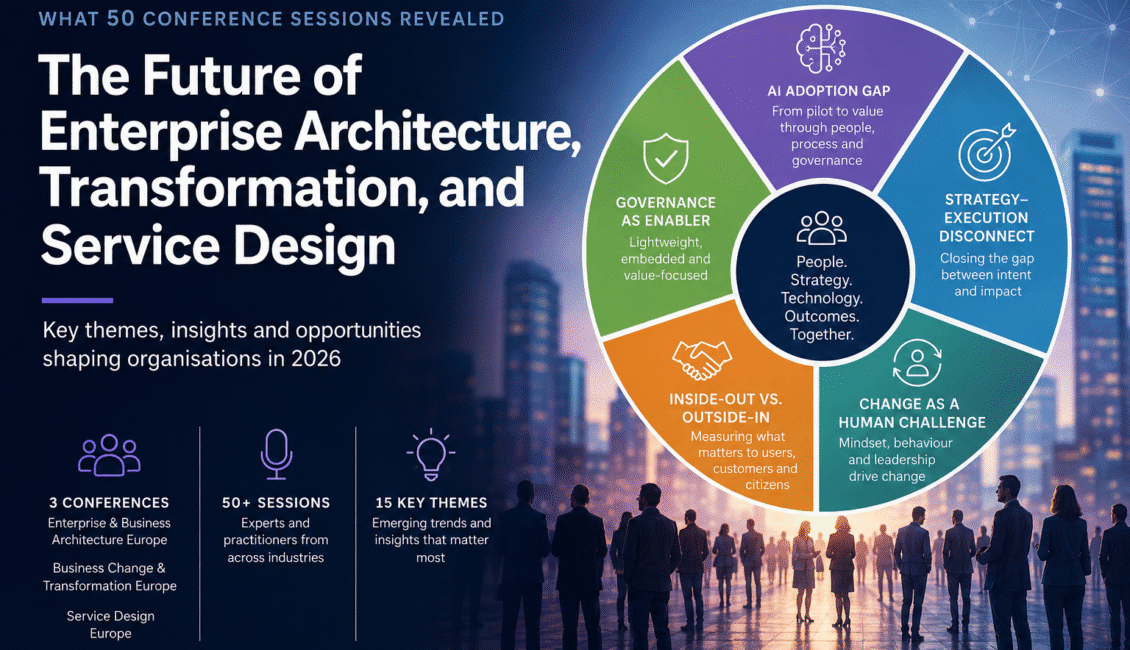
The future of enterprise architecture, transformation, and service design was a central theme across more than 50 sessions at the IRM UK Enterprise & Business Architecture Conference Europe, Business Change & Transformation Conference Europe, and Service Design Conference Europe 2026. This report, by Martin Sykes, Business AI Adoption Lead at Redgate Software, former Conference Chair, and member of the Conference Advisory Board (and AI Support), highlights the themes that appeared most frequently across the conference programme and what they reveal about the state of organisations in 2026.
Conference Themes & Insights
Theme List, Ordered by Frequency
| # | Theme | Session count | Brief description |
| 1 | AI adoption gap | 15 | The persistent gap between deploying AI tools and realising value from them. A change and behaviour challenge, not a technology one |
| 2 | Architecture as strategic enabler | 14 | Repositioning EA and BA from documentation/compliance functions to decision-support and value-creation roles |
| 3 | Change as a human challenge | 13 | Why transformation fails because of people factors: mindset, belief, leadership behaviour, informal networks — not plans or tools |
| 4 | Strategy-execution disconnect | 12 | Moving governance from a heavyweight gate to lightweight, embedded, self-service mechanism that accelerates rather than blocks |
| 5 | Inside-out vs. outside-in | 11 | The gap between how organisations measure themselves internally and how value is actually experienced by users, customers, or citizens |
| 6 | Governance as enabler | 11 | BA, EA, and Service Design are converging, requiring practitioners to work across traditional discipline boundaries |
| 7 | Demonstrating value | 10 | Translating architecture, design, and change work into language that resonates with financial and executive decision-makers |
| 8 | Capability mapping | 9 | The use of business capability models as a stable, strategy-aligned language for investment decisions and their blind spots |
| 9 | Becoming a service organisation | 9 | The structural, cultural, and design shift required to move from functional efficiency to end-to-end service delivery |
| 10 | Responsible and ethical AI | 8 | Governance, explainability, transparency, and accountability in AI deployments across the lifecycle |
| 11 | The interdisciplinary turn | 8 | What leaders visibly do, not what they say, is the dominant determinant of organisational culture and change outcome |
| 12 | Legacy, complexity, and debt | 7 | The accumulation of technical and architectural complexity and the honest accounting required to address it |
| 13 | Moving governance from a heavyweight gate to a lightweight, embedded, self-service mechanism that accelerates rather than blocks | 7 | Leadership behaviour as a cultural signal |
| 14 | Public sector transformation | 7 | The distinctive constraints, governance requirements, and human-scale stakes of transformation in government and public institutions |
| 15 | Behavioural science in change | 5 | Applying dual-process theory, social norms, loss aversion, and friction reduction to make change programmes more effective |
Top Five Themes in Depth
Theme 1: The AI Adoption Gap
Sessions: Adams & Rosmann-Begg; Ali & King; Bradley; Diaz; Farmer; Ferriman; Gokharu; Hankey; Kortleven; Lundgaard; Rangaswamy & Lloyd; Schroeder; Aaberg (implied); Van der Merwe; Hatton
The single most prominent theme across IRM 2026 is not AI itself — it is the chronic failure to convert AI investment into organisational value. Presenter after presenter arrived at the same diagnosis from different directions: the technology is not the problem. The problem is everything else.
The data is stark. Adams and Rosmann-Begg opened with the industry baseline: 88% of organisations have deployed AI tools; only 6% realise meaningful returns; 70% of pilots never scale. Diaz documented 26 AI agent rollbacks between mid-2024 and mid-2026 — including DPD, Air Canada, McDonald’s, and Klarna — and argued that in every case, AI had not failed; the underlying service model had failed first. Farmer noted that 90% of AI projects never scale, and that the failure is organisational rather than technical. Ferriman added that 88% of HR leaders (Gartner, 2025) say AI investments have not yet generated significant value, with 41% of AI investment targeting tasks workers themselves consider low-priority or unsuitable for automation.
What makes this theme coherent across the conference is the shared diagnosis: organisations treat AI adoption as a deployment event rather than a behaviour change programme. Adams and Rosmann-Begg demonstrated at Whitbread that branding, sprint-based learning, peer community, and role-specific scenario training, not licence rollout, drove results. Hankey found the same at The Economist Group: generic “here’s what Copilot can do” training produced awareness but not use; reframing training around Jobs-to-be-Done for each specific role changed the outcome. Gokharu, reflecting on two years of daily AI use as a BA, offered the practitioner’s view: AI is genuinely useful as a first-draft generator and synthesis engine, and genuinely unreliable for politically nuanced stakeholder work. The skill is selective deployment, not wholesale adoption.
Several presenters sharpened the point about organisational prerequisites. Farmer argued that organisations need a specific maturity level before AI investment pays off: structured pilots with clear ownership, talent who can operationalise beyond the prototype, and governance structures that don’t exist yet in most organisations. Diaz framed this as a “Minimum Maturity State”: end-to-end service integration must precede AI deployment, because AI amplifies whatever capability exists and most service models are too fragmented to amplify. Schroeder raised the architectural implication: AI systems make decisions at machine speed, but EA governance operates at human speed. The infrastructure for governing AI reliably does not yet exist in most enterprises.
The conference did not produce one answer to the adoption gap. It produced several that reinforce each other: fix the underlying processes before you automate them; design adoption as a behaviour change programme, not a training event; build organisational governance before you scale; measure outcomes (value) not activity (prompts, sessions, licences). The consistent subtext across 15 sessions is that the organisations winning with AI are the ones that treated it as an organisational challenge first and a technology challenge second.
Theme 2: Architecture as Strategic Enabler
Sessions: Aaberg; Banner & Pelser; Burlton; Christensen & Stender; Clinch; Gassis; Gama; Hatton; Hemingway; Lundgaard; Marchese; Schroeder; Sykes; Van der Merwe; Windle; Yates
The second major theme is the repositioning of Enterprise and Business Architecture from technical compliance functions into strategic decision-support capabilities. This conversation ran across every track and most days of the conference, suggesting it is the central professional preoccupation of the architecture community right now.
The problem was consistently the same. Gassis named it directly: “architects are librarians” engaged late, asked to review decisions already made, producing documentation that does not drive outcomes. Marchese called it a failure of positioning: architecture functions that report into IT rather than strategy are structurally prevented from being strategic. Yates described the CIO challenge that triggered his team’s transformation: “You’re too slow, too expensive, and nobody can tell me what you’ve actually delivered.” Aaberg observed that architecture diagrams alone do not create transformation — governance does. Each presenter was describing the same structural trap: an EA function doing the right work in the wrong place at the wrong time.
The proposed solutions share a common logic, though each was arrived at independently. Gassis introduced a seven-step framework at Benefact Group centred on starting from outcomes, not solutions, using service blueprints and capability models to clarify intent before solutions are discussed, then sequencing investments by value-unlocking order rather than activity timeline. Sykes at Redgate described “invisible governance” as governance embedded into existing delivery workflows (PRs, wikis, sprint reviews) rather than running in parallel, with Architecture Decision Records providing self-service governance. Yates redesigned the engagement model at Anglian Water from a review board into three distinct modes: on-demand advisory (fast, light-touch), structured engagement (2–4 week sprint), and strategic partnership for major programmes. Within nine months, business leaders who had previously avoided the EA function were proactively seeking it out.
Gama contributed the most distinctive argument of the conference: even a well-functioning capability-based EA model has a fundamental blind spot. Riot Games built a solid capability operating model in 2025 and discovered by 2026 that it measured internal maturity but not how value was experienced by users. A Travel and Expense process scoring 4/5 internally produced an 18-day reimbursement wait against a 7-day target. The fix is to complement capability views (inside-out: what the organisation does) with service views (outside-in: how value lands). Schroeder extended the argument into the AI era: EA must evolve from producing human-speed governance artefacts to being a machine-readable, queryable source of organisational truth. Architecture as an operating system rather than a document repository.
What connects all 14 sessions is an implicit agreement on what architecture is for: faster, better-informed decisions; reduced duplication; earlier risk visibility; fewer costly reversals. The disagreements are about method, not purpose. And the sessions that showed the most traction — Sykes, Yates, Christensen & Stender, Windle — were those that made architecture concrete, measurable, and embedded in delivery rather than parallel to it.
Theme 3: Change as a Human Challenge
Sessions: Adams & Rosmann-Begg; Ali & King; Andresen & Claxton; Bradley; Farmer; Ferriman; Hankey; Höök; Kortleven; Nwodo & Wakeley-Jones; Palmer-Trew; Pullen-Ferreira; Stjernholm
The third dominant theme is the consistent failure of change programmes that treat transformation as primarily a planning and delivery problem rather than a human and social one. Thirteen sessions, across all three conference tracks, converged on this point, making it as much a theme of the Architecture and Service Design tracks as of the Change and Transformation track.
Bradley’s contribution was the clearest diagnosis. “Change fatigue”, the industry’s standard explanation for why people disengage from change, is almost always misdiagnosed. True fatigue is a capacity problem: people cannot absorb more change. Disengagement is a motivation problem: people will not engage because the change is not worth it to them. The remedies are different; applying fatigue remedies to disengagement makes things worse. The ShiftSync case made this concrete: 92% e-learning completion, 81% log-in rates, and only 23% active use. The tool was never the problem. The old channels were never removed, the rules never changed, and sponsorship faded after sign-off. Organisations prove to themselves that people are fatigued when they weren’t because misdiagnosis and its remedies generate the fatigue they claim to manage.
Kortleven (opening keynote) placed this in a deeper argument. Most change programmes are designed around the Blueprint Mindset: change is a project; it ends at go-live; success is on-time and on-budget. But people do not experience change as something to manage, they experience it as something that happens to them, and specifically as loss, not gain. Research consistently shows that the framing, not the content, determines whether people engage. Most organisations invest 80% of change effort in logistics and 2% in shifting belief, the inverse of what produces sustained adoption.
Palmer-Trew provided the scientific substrate. Employees operating under System 1 (automatic, emotional, habit-driven) thinking, which is most of the time, are not reached by rational communications about benefits. Loss aversion means that framing a change as avoiding a loss is consistently more motivating than framing it as gaining a benefit. Social proof from a specific named peer (“Your team lead, Sarah, has already switched”) outperforms broad adoption statistics. Reducing friction (for example, the number of steps required to try something new) is one of the highest-leverage change design interventions available. Pullen-Ferreira added the network dimension: resistance travels through informal channels before it surfaces formally. The organisation’s informal connectors receive and amplify negative signals faster than any formal communication plan can counter.
Andresen and Claxton brought the leadership perspective. They identified three hidden risks that erode transformation capacity from within: Capacity Risk (leaders burning out), Relational Risk (trust eroding into surface compliance), and Judgement Risk (decision quality degrading under sustained pressure). These are the real reasons transformation failure rates remain at ~70% despite better methodologies. The conclusion shared across all 13 sessions: change management is a professional discipline that requires the same rigour as architecture or service design, and organisations consistently under-invest in it, particularly in the human and leadership dimensions that ultimately determine whether change sticks.
Theme 4: The Strategy-Execution Disconnect
Sessions: Banner & Pelser; Burlton & Kuehn; Gama; Gassis; Höök; Houghton; Lozefson-Schneider; Stjernholm; Windle; Yates; Stow; Schroeder
The fourth major theme is the systematic loss of strategic intent as it moves from executive articulation into delivery reality. Twelve sessions named and addressed a version of the same problem: organisations produce good strategy and fail to execute it, not because the strategy is wrong, but because the connective tissue between strategy and daily work does not exist or breaks under pressure.
Lozefson-Schneider named the core pattern “strategy evaporation.” Strategic intent is progressively diluted at five predictable checkpoints: business case translation, programme scoping, sprint planning, backlog prioritisation, and delivery team briefing. Each transition introduces distortion where cost constraints force scope cuts that are never re-validated against the original strategic outcome; by the time a team is doing the work, the strategic reason for it is invisible. The fix they proposed, traceability from Strategic Goal through Outcome, Programme, Project, to Delivery Task, maintained explicitly at each layer, sounds mechanical but addresses a genuine structural failure.
Stjernholm’s framing was complementary: “strategy is easy because it lives in slide decks and workshops.” The hard part is translating strategy into the micro-decisions of thousands of frontline employees who have never seen the strategy document. The most reliable test of strategy execution is direct: ask frontline employees what they would do differently today because of the strategy. Inability to answer is diagnostic. The gap is almost always in middle management, who are usually told what to communicate but given no help on what it means for their specific team’s daily work. Incentive structures that reward activity metrics (volume, speed) rather than strategic outcomes actively contradict strategy execution regardless of communications quality.
Gama illustrated the same problem from an architectural angle. Riot Games’ EA model (as noted in the earlier theme) is a strategy-execution gap: the strategy called for an effective T&E capability; the execution delivered an internally mature but externally broken one.
Banner and Pelser showed what closing the gap can look like in practice. Royal London discovered that 80%+ of initiatives were being excluded late in the business planning cycle after significant design effort because there was no shared view of strategic intent and capability status before planning began. The solution was a set of “strategy handbooks” per value stream, produced early, giving business leaders and architects a common language for trade-offs. The handbooks did not add bureaucracy; they shifted where in the cycle conversations happened. Burlton and Kuehn (opening plenary) framed the meta-challenge: most organisations structure but do not design. They create hierarchy and delegate, resulting in organisation-wide structures but no organisation-wide design and without deliberate design, cohesion cannot emerge.
Theme 5: Inside-Out vs. Outside-In
Sessions: Bell & Bromey; Catchick; Cusworth-Bolger; de Voil; Diaz; Gama; Houghton; Platt; Prendergast; Rourke; Clinch
The fifth cross-conference theme is the persistent gap between how organisations measure themselves internally and how their outputs are actually experienced by the people they serve. Eleven sessions from all three conference tracks converged on this distinction, making it one of the few themes that genuinely unified architects, change practitioners, and service designers.
The problem has a consistent shape across contexts. Organisations optimise internal metrics (process maturity scores, training completion rates, compliance levels, cycle times) and discover that these measurements describe the inside of the system, not the experience of the person using it. Catchick documented the gap in customer experience: Bain measured a 72-point gap between company self-assessment and customer experience in 2005; Amdoc measured a 56-point gap in 2025. Twenty years and the gap has barely moved.
Houghton framed the institutional consequence at HMRC. Service design outputs (journey maps, experience blueprints, user research) are invisible to the financial decision-makers who allocate investment. Translating user needs into monetised outcomes (avoidable contact rates, cost-per-contact, annual cost avoidance) is not a concession to a finance-speak culture; it is the service designer’s responsibility to speak the language of the decision-maker. “No one said no to a journey map. They just didn’t fund it.” The outside-in view has to be expressed in the inside-out language of the organisation to get traction.
Prendergast illustrated the structural root cause at HMRC: the organisation is structured by tax type, not by user journey. A self-employed person filing a return interacts with income tax, national insurance, VAT, and self-assessment as if they were separate organisations. The outside-in view reveals a coherent user need; the inside-out structure produces fragmentation. Diaz made the same point about organisations that deployed AI agents: the internal service model looked functional per silo; the end-to-end user experience was broken. AI exposed and amplified the fragmentation already present.
Rourke contributed the accessibility dimension. Designing for the average user, a fiction that excludes approximately 22% of the UK adult population who have a disability, is itself an inside-out failure. Designing for the extremes of the user population (a genuinely outside-in orientation) systematically produces better services for everyone: the “curb-cut effect” applied to service design. De Voil provided the systems thinking frame that ties these cases together. Service failures that appear as individual step failures are almost always produced by systemic dynamics (feedback loops and incentive structures) that standard service blueprints do not model. Fixing the step without fixing the system produces a temporary improvement followed by a regression. The outside-in view must reach all the way to system dynamics, not just to the visible service interaction.
Conference Themes: Executive Summary
Source: Co-located conference of Architecture, Change & Transformation and Service Design.
Every presentation deck was read by AI to extract structured notes, which were then analysed to identify recurring themes, ranked by the number of sessions each appeared in as a primary or substantial concern. This summary presents the top five themes with supporting evidence.
While the conference brought together three distinct professional communities, Enterprise Architecture, Business Change & Transformation, and Service Design, the themes that emerged were remarkably consistent.
Across more than 50 sessions, speakers repeatedly returned to the same fundamental challenges: translating AI investment into value, connecting strategy to execution, demonstrating impact, governing complexity, and helping people adapt to change.
Perhaps the strongest message from the week is that organisations can no longer address these challenges in isolation. Architecture, transformation, service design, governance, leadership, and technology are becoming increasingly interconnected disciplines. The organisations most likely to succeed will be those that can bridge these perspectives, creating clearer alignment between strategy, delivery, customer outcomes, and organisational capability
The organisations most likely to succeed will be those that can bridge these perspectives, creating clearer alignment between strategy, delivery, customer outcomes, and organisational capability.
The conversations from this year’s conference suggest that while the challenges facing organisations continue to grow in complexity, the opportunities for collaboration across disciplines have never been greater.