When Everyone Owns Part of the AI, Who Owns the Decision?
Itohowo Charles, Product Owner/ Senior Business Analyst, Capgemini
AI is moving quickly into everyday business processes.
It is helping organisations review transactions, rank cases, assess information, recommend actions and increasingly carry out tasks through AI agents.
At the same time, expectations around AI governance are becoming more serious.
On 2 August 2026, new transparency requirements under the EU AI Act started to apply, alongside stronger enforcement powers. In the US, NIST has launched work specifically focused on AI agents, including their security, identity and ability to operate across different systems. In the UK, the Responsible AI Advisory Panel is also looking at how accountability, assurance and responsible AI should work across the public sector.
These developments point to a bigger question for organisations:
When AI contributes to a decision, who is actually accountable for what happens?
Everyone owns something
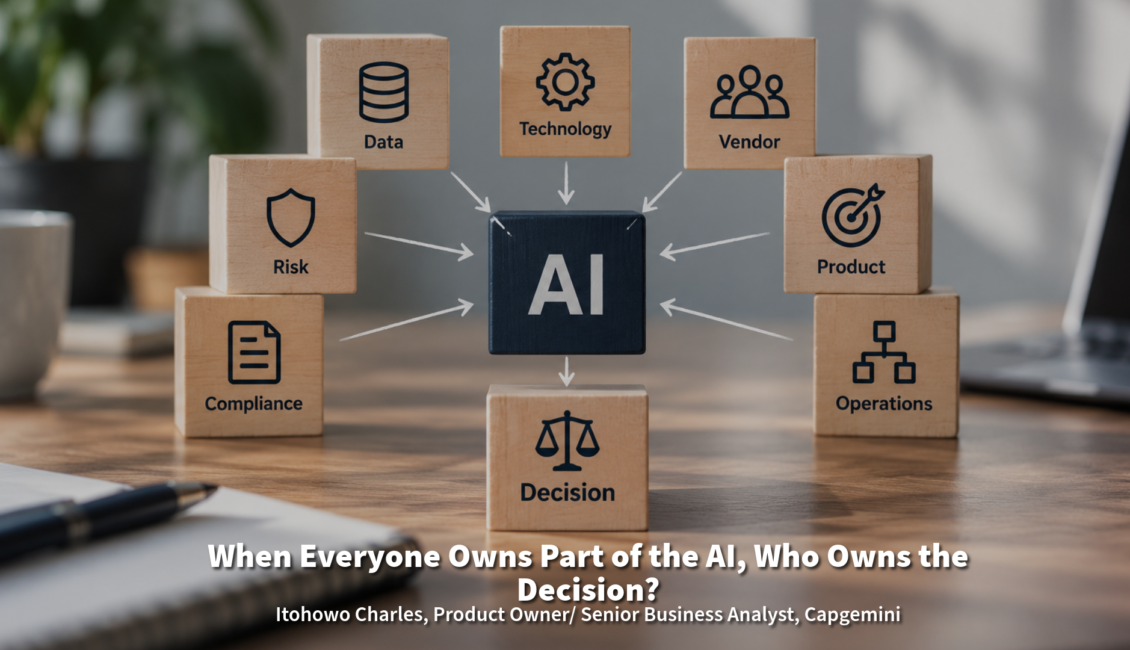
Most organisations already have people responsible for different parts of AI.
The data team may be responsible for the data. Technology owns the application and infrastructure. A vendor may provide the model. Product teams manage the use case. Operations owns the process. Risk, legal and compliance provide oversight.
There can be plenty of responsibility across all these teams.
The problem appears when we ask who owns the final outcome.
Imagine an AI-enabled process produces a poor outcome for a customer.
The model may have performed within its agreed limits. The application may have worked correctly. The data may have passed its quality checks. The process may even have followed the rules configured within it.
Yet the customer still received the wrong outcome.
Who answers for that decision?
This is where accountability can become unclear. Responsibility has been divided across many teams, but the final decision may have no obvious owner.
Business ownership and technical ownership are different
One way to address this is to separate two types of ownership.
Technical ownership covers the AI system itself. This includes architecture, security, model performance, integrations, monitoring and incident management.
Business ownership covers the decision and its consequences.
For example, if AI supports a credit decision, the technology team may be responsible for ensuring that the system works correctly. But somebody within the business should still be accountable for how that credit decision is made and the impact it has on the customer.
The same principle applies to recruitment, fraud detection, insurance, healthcare, customer service and many other areas.
This becomes even more important as organisations adopt AI agents.
NIST describes AI agents as systems capable of taking autonomous actions. Current examples include agents that can work with emails and calendars, write code and interact with other digital systems. NIST’s work in 2026 has highlighted questions around agent security, identity and authorisation.
If an AI system can move beyond providing information and start taking actions, organisations need to be clear about the authority they are giving it.
Who approved that authority?
What can the agent do without human approval?
What happens when it makes a mistake?
And who is responsible for the result?
The level of governance should match the decision
Not every AI use case creates the same level of risk.
An AI tool that summarises an internal meeting is very different from a system that recommends whether someone should receive a loan.
An AI assistant that drafts an email is also different from an agent that can access a customer’s account and perform an action.
Organisations should therefore look at the role AI plays in each process.
Does it provide information?
Does it recommend an action?
Does it rank or prioritise cases?
Can it make the decision automatically?
Can it take action without further approval?
The greater the impact and autonomy, the stronger the governance should be.
The EU AI Act also takes a risk-based approach, with requirements depending on the type of AI system and how it is being used. New transparency requirements applying from August 2026 are one example of regulators putting clearer expectations around how AI is deployed.
Human oversight needs to mean something
Human oversight is often presented as the answer to AI risk.
But simply placing a person somewhere in the process does not automatically provide effective oversight.
The person needs to know what they are reviewing. They need enough information to question the AI output. They also need the authority to reject, change or escalate the decision.
Consider a reviewer who receives an AI recommendation but is expected to approve hundreds of cases each day. If they rarely have enough time or information to challenge the recommendation, there may technically be a human in the process, but the control is weak.
For important decisions, organisations should clearly define when human review is required, what should trigger an escalation and who has the authority to stop the process.
This is particularly important when the decision is difficult to reverse or could have a significant impact on someone.
We also need a decision trail
Audit logs usually tell us what a system did.
For AI-enabled decisions, organisations may need something more.
They need to be able to reconstruct the decision.
What information was available at the time?
What did the AI produce?
Which model or version was used?
What business rules were applied?
Did a person review the recommendation?
Did they accept, change or reject it?
What action followed?
And who owned the final decision?
I think of this as a decision trail.
This becomes valuable when a customer challenges an outcome, when an auditor asks for evidence or when an organisation needs to understand why something went wrong.
The focus moves beyond whether the technology was working. It helps the organisation explain how the actual decision was reached.
Making ownership practical
Organisations do not necessarily need another large governance committee to solve this.
For every important AI use case, a few questions can make ownership much clearer:
- What decision is AI supporting or making?
- Who is accountable for the business outcome?
- Who owns the technology behind it?
- What authority has been given to the AI?
- When must a human intervene?
- Can we reconstruct the decision afterwards?
A RACI model can also help make the roles clearer by identifying who is responsible, accountable, consulted and informed.
The important point is that there should be a named person accountable for the outcome. A committee can provide challenge and oversight, but it should not make accountability impossible to find.
The governance conversation is changing
This question is becoming more important because AI itself is changing.
AI systems are being connected to more organisational data, applications and workflows. Agents are being given greater ability to act. Regulation and public expectations are also developing.
The UK government’s Responsible AI Advisory Panel discussed this issue from another angle in September 2026, including responsible AI procurement, assurance, accountability and how governance arrangements should develop across the public sector.
Organisations therefore need to think beyond who owns the model.
They need to know who owns the decision the model, application or agent helps create.
When something goes wrong, a customer will not care that one team owned the data, another owned the model and another managed the application.
The organisation will still need to explain the outcome.
And somebody needs to be accountable for it.
This is the question I will explore further at the Data & AI Conference Europe 2026 in my session, “AI Decisions Without Ownership: Risks, Gaps, and Practical Governance.”
As AI becomes part of more important decisions, clear ownership may become one of the most important parts of responsible AI governance.