What Kind of Curious Are You? Exploring the Power of Curiosity
Like many parents, I remember the “why?” phase like it was yesterday.
When my son was young, every answer seemed to generate another question.
Why is the sky blue?
Why don’t dinosaurs exist anymore?
Why can’t I put ketchup on my ice cream?
The questions came in an endless stream. Curiosity, expressed through a relentless desire to understand how the world worked.
A few years later, I found myself observing a different type of curiosity.
My daughter is autistic and has a severe learning disability. Her vocabulary is limited, so her curiosity does not take the form of questions.
Instead, she explores. Relentlessly.
She’ll stop to inspect an insect she finds in the garden. She’ll follow the path less trodden on woodland walks. She’ll dive headfirst into an Amazon box moments after it lands on the doorstep.
She interacts with the world in a way that is immediate, unfiltered and deeply inquisitive.
Watching her, I realised that curiosity takes many forms.
My son’s curiosity seemed to be driven by questions.
My daughter’s curiosity seemed to be driven by exploration.
Both were intensely curious. They simply expressed it in different ways.
That observation stayed with me and the more I looked, the more I noticed curiosity appearing in different forms all around me.
Some people ask questions. Some explore. Some create. Some experiment.
I became, quite literally, curious about curiosity.
When the opportunity arose to submit a session for the European Business Analysis Conference, I decided to pull on that thread.
That journey eventually led me to the Britannica Curiosity Compass, a framework that describes four different expressions of curiosity.
Curiosity, however, rarely follows a straight line and the more I thought about it, the more it seemed that a presentation about curiosity should be anything but predictable.
So rather than creating a traditional conference session, I decided to build something a little different.
My session takes the form of a Choose Your Own Adventure. At five key points during the presentation, the audience’s collective curiosity will determine where to go next. Each choice influences the route we take through the session, guiding us towards different stories, examples and perspectives.
Five decision points. Three choices at each. That’s 243 possible variations of the presentation.
The precise route we take depends entirely on the collective curiosity of the audience. However, what is guaranteed is that along the way we’ll encounter four curiosity archetypes.
The Explorer is drawn to discovery, novelty and new experiences. The Artist seeks meaning, perspective and human connection. The Inventor imagines what could be and looks for ways to make it real. The Scientist wants to understand how things work and follows evidence wherever it leads.
Most people will recognise a little of themselves in one archetype. Many will see aspects of themselves in all four.
My hope for the session is a simple one – that people leave with a little more curiosity than they arrived with.
Where that curiosity leads is anyone’s guess.
And that’s the wonderful thing about curiosity. You never quite know where it might take you.
Join Simon at BA2026
Curiosity doesn’t always look like asking more questions. It can mean exploring, experimenting, creating, challenging assumptions or simply choosing to follow a path because you want to know where it leads.
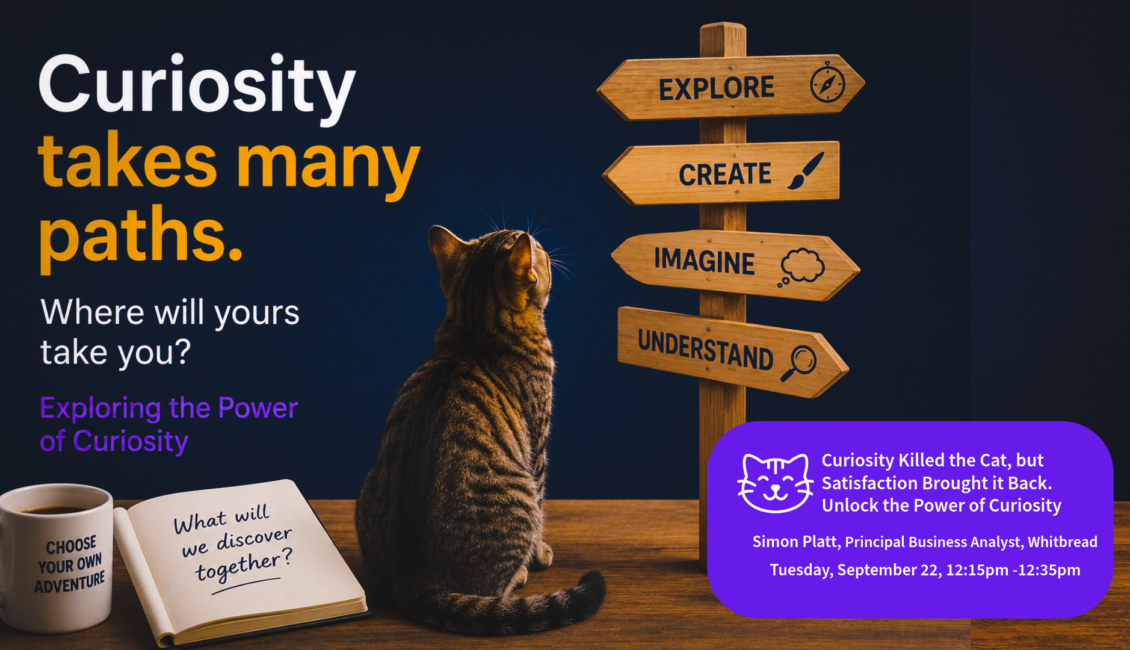
At the Business Analysis Conference Europe 2026, Simon Platt, Principal Business Analyst at Whitbread, will put that idea into practice in Curiosity Killed the Cat, but Satisfaction Brought it Back. Unlock the Power of Curiosity.
And this won’t be a traditional conference presentation.
Inspired by the Choose Your Own Adventure books, the audience will decide where the session goes next, creating potentially 243 different versions of the experience. Along the way, Simon will explore the Artist, Explorer, Inventor and Scientist curiosity types and what they can teach us about the way we analyse, solve problems and approach change.
If you want to rediscover some of the curiosity that came so naturally as a child, this is 20 minutes of BA2026 you won’t want to miss.
Curiosity Killed the Cat, but Satisfaction Brought it Back. Unlock the Power of Curiosity
📅 Tuesday 22 September 2026 | 12:15pm–12:35pm
📍 Business Analysis Conference Europe 2026, London
Where will the session go? You’ll have to be in the room to help decide.