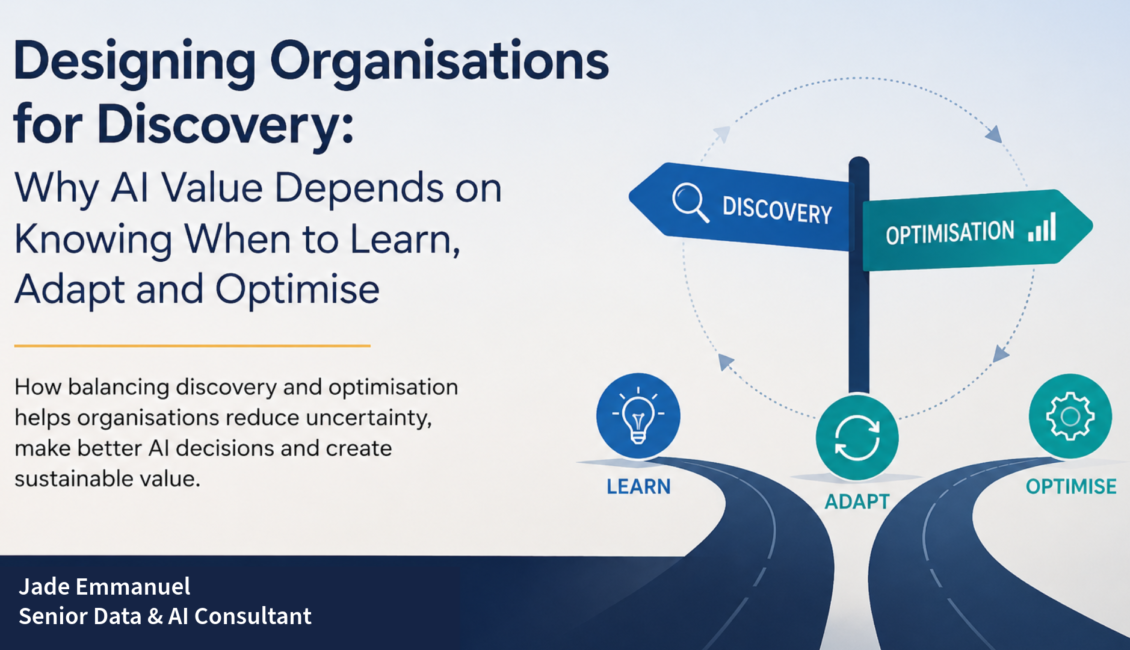
Designing Organisations for Discovery: Why AI Value Depends on Knowing When to Learn, Adapt and Optimise
Jade Emmanuel, Senior Data & AI Consultant
The Problem With Optimising Too Early
AI use has become common inside organisations, but enterprise-wide value remains much less consistent.
McKinsey’s 2025 State of AI survey found that 88% of respondents said their organisations were regularly using AI in at least one business function. Yet nearly two-thirds had not begun scaling AI across the enterprise, and only 39% reported any impact on enterprise-wide operating profit. Among those that did, most said AI accounted for less than 5% of that profit.
The gap between adoption and material value points to a wider organisational challenge. Access to capable technology matters, but value depends on whether the organisation can recognise where that capability should be applied, test its assumptions and change direction when the evidence requires it.
Historically, businesses have developed considerable expertise in optimisation. They know how to improve established processes, reduce costs, increase consistency and execute a defined strategy more efficiently. Those disciplines remain essential, and many worthwhile AI initiatives will depend on them. The difficulty, however, arises when optimisation becomes the default response before the opportunity has been properly understood.
Consider these example scenarios: An organisation identifies an existing process and asks where AI can make it faster. It examines a role and asks which tasks can be automated. It takes the current customer journey and looks for stages where effort or cost can be removed.
These are legitimate questions when the problem and desired outcome are clear; they become limiting when the current process is treated as the boundary of the opportunity.
AI creates an important opportunity to reconsider products, decisions and operating models. It also makes it easier to scale weak assumptions, process flaws and poor decisions before they have been properly examined. When the current process becomes the primary frame for an AI initiative, the organisation limits itself to improving what already exists and risks making embedded problems faster, larger and more difficult to reverse.
The more useful starting point is therefore not only where AI can be introduced into the organisation as it operates today, but what the organisation would design differently around the capabilities now available.
Two Modes of AI Value Creation
I find it useful to distinguish between two modes of work: optimisation and discovery.
Optimisation begins with something sufficiently understood and asks how it can be improved. The problem is defined, the intended outcome is reasonably clear, and value is likely to come from greater speed, consistency, quality or efficiency.
Discovery begins with an opportunity or problem that remains partly unresolved. Important assumptions still need to be tested, and what the organisation learns may change the process, product or operating model it eventually chooses to pursue.
Both modes create value, but they require different questions and measures.
An optimisation initiative can usually be assessed against an established baseline. Discovery has a different initial purpose: to reduce enough uncertainty for the organisation to decide what deserves further investment.
Progress may mean invalidating an assumption, establishing that the original use case is too narrow or finding that the greater opportunity sits elsewhere. These outcomes can appear unproductive when measured using delivery metrics, even though they may prevent the organisation from investing significantly more in the wrong direction.
Discovery should not mean unstructured experimentation. It still requires a defined problem, accountable ownership and evidence that determines whether the work continues, changes direction or stops.
Discovery and optimisation are not competing approaches. Discovery establishes where value lies. Optimisation makes that value reliable and scalable.
The leadership challenge is recognising which mode the opportunity currently requires.
Learning While the Opportunity Can Still Be Shaped
Across established enterprises and early-stage product environments, I have seen valuable progress come from learning something important early enough to change direction while the opportunity could still be shaped.
This matters because many AI decisions have limited precedent. Leaders are evaluating capabilities that continue to develop, customer behaviours that have not stabilised and operating implications that cannot be understood through analysis alone. Some questions can only be resolved by testing the technology in context and examining what happens.
Waiting for every uncertainty to disappear can delay the learning needed to make a sound decision.
Organisations therefore need more than permission to experiment. Teams should know which assumptions they are testing, what evidence they need and who is accountable for deciding what happens next. That evidence must also reach the people with the authority to change funding, priorities or direction.
Without these disciplines, discovery becomes a collection of pilots that produces activity without creating direction. With them, learning becomes part of how the organisation makes strategic decisions.
A Test of Organisational Learning
Before approving the next AI initiative, leaders should ask five questions:
- Is the opportunity sufficiently understood to optimise, or are important assumptions still untested?
- What evidence would cause us to change direction?
- How quickly can that evidence reach the people accountable for the decision?
- Can teams challenge a predefined use case when the evidence points towards a more valuable one?
- If we designed this organisation today around the capabilities AI now provides, what would we build differently?
Weak answers will reveal constraints that more capable technology alone will not resolve.
When to Discover, When to Optimise
The transition between discovery and optimisation is not always obvious.
Discovery without a decision point becomes experimentation without consequence, and should be expected to produce evidence and direction, even when it does not produce an immediate return. Optimisation introduced too early can scale work before the organisation has established that it is the right work to be done. It should have a sufficiently clear baseline and account of value to justify investment in scale.
The transition should be driven by evidence rather than confidence alone. Teams should be explicit about which assumptions have been tested, what remains uncertain and what would justify further investment. They should also understand which unanswered questions could materially change the opportunity and which can be managed as the work progresses.
The required evidence will vary according to the decision and the consequences of getting it wrong. An internal productivity tool should not be expected to meet the same standard as a system influencing regulated or high-impact decisions. Different thresholds are appropriate, but those thresholds should be deliberate.
A team may also move between the two modes several times. Discovery may reveal a valuable opportunity that can then be optimised. New evidence may later expose an assumption that requires the organisation to return temporarily to discovery. It is a fluid model that requires continuous monitoring and learning to determine when to move between the two modes.
Organisations will continue to need operational excellence, thoughtful governance and disciplined execution. AI does not reduce the importance of those capabilities; it makes the timing of their application more consequential.
Before making something faster, cheaper or easier to scale, establish that it is worth scaling. Then make learning part of the decision itself: know what evidence matters, what would change your mind, and when it is time to move from discovery to optimisation.
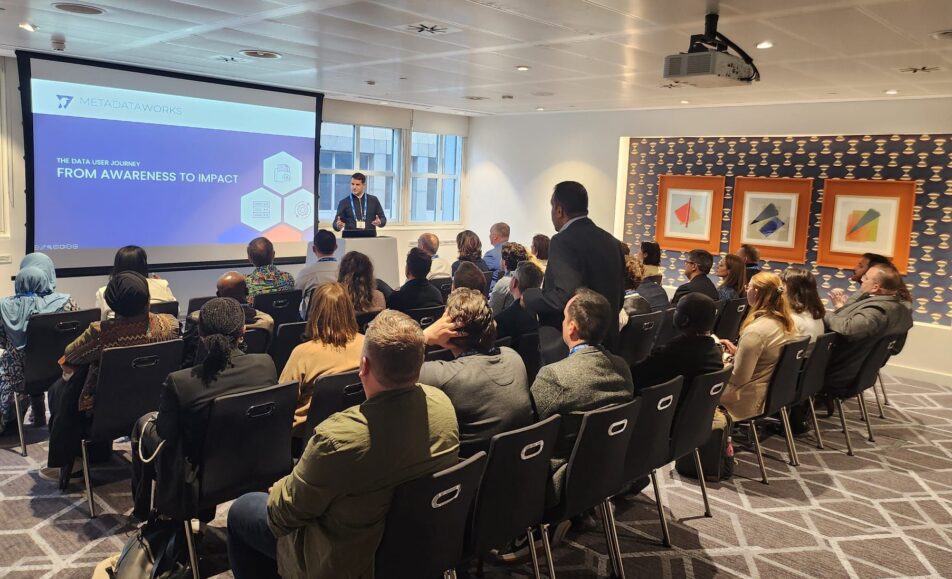
Jade Emmanuel will develop this distinction into a practical leadership model at the IRM UK Data & AI Conference in November 2026.