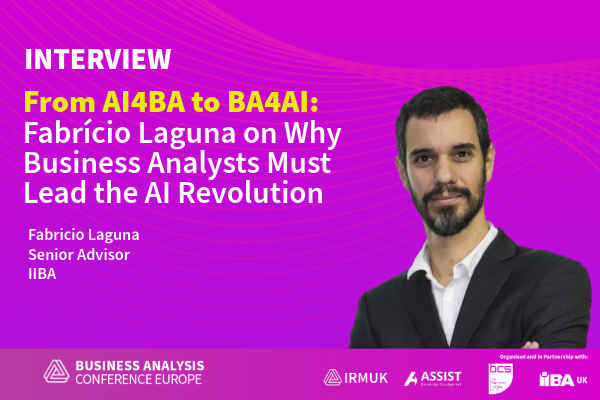
From AI4BA to BA4AI: Fabrício Laguna on Why Business Analysts Must Lead the AI Revolution
Artificial Intelligence is changing the way organisations operate, but what role should Business Analysts play in shaping that future? Ahead of his session, FROM AI4BA TO BA4AI: Empowering Business Analysts to Lead the AI Revolution, we spoke with Fabrício Laguna, Senior Advisor at IIBA and one of the most recognised voices in the global Business Analysis community.
In this interview, Fabrício shares his perspective on the opportunities and risks of AI adoption, why Business Analysts are uniquely positioned to lead AI initiatives, and how the profession must evolve from simply using AI tools to actively guiding AI-driven transformation.
1. Your session explores the shift from AI4BA to BA4AI. What sparked your interest in this evolution of Business Analysis?
It started from a conversation I had with my friend from Australia, Michael Augello. He was concerned about spreading awareness of the impact AI would have on organisations and society in general, and how the Business Analysis practitioner community still seemed somewhat unaware of it.
We saw talks, courses, and articles focused on how to use AI during Business Analysis work (AI4BA). That is important and useful, but it limits Business Analysts to seeing themselves as “mere users” of AI, impacted by a transformation they are not actively part of.
That perspective is far too limited. Business Analysis is the practice of enabling change. We are agents of organisational transformation, and we need to take a leadership position in AI adoption to ensure that outcomes generate the right value for stakeholders.
From that conversation came an article published in The Corner by IIBA (https://www.iiba.org/iiba-the-corner/business-analysis-for-artificial-intelligence/).
This session is part of that same initiative: a call for the Business Analysis community to step forward, assume this leadership role, and help shape the direction organisations take in their AI initiatives. #BA4AI
2. AI is moving incredibly fast right now. Why do you believe Business Analysts are uniquely positioned to help organisations navigate this change?
The speed is truly frightening, and this unstructured evolution brings enormous risks that need to be mitigated. We need AI adoption to happen for the benefit of people and society, not at the expense of what we consider valuable.
Business Analysis professionals are trained to think holistically and in an outcome-driven way. Analysis techniques enable them to ask the right questions and focus efforts and investments on initiatives capable of generating real value.
Their facilitation and mediation skills place them in a key position to bring together professionals with different perspectives to discuss the direction of AI development, not merely from a technology perspective, but through a business language.
3. Without giving too much away, what’s one mistake organisations commonly make when approaching AI initiatives?
Probably the most common mistake is being driven by the AI hype and allocating large amounts of resources into initiatives with vague definitions of objectives or expected benefits.
Teams start working without a clear strategy, and later, executives begin demanding ROI through workforce reductions carried out in a poorly thought-out and irrational manner.
Some companies have publicly admitted regretting having followed this wave and are now reversing course. Replacing human labour with AI can be harmful for organisations because they lose knowledge, culture, connections, and employee morale. And it is certainly harmful to society as well.
4. Your session introduces the FABR Framework. What inspired you to create it, and what kinds of challenges does it help address?
I wanted to provide clear guidance for analysts dealing with organisational transformation initiatives involving AI. Something practical they could use in their daily work to guide discussions with stakeholders and teams.
I analysed several models to synthesise the main concerns that should guide these professionals into what I called FABR – Five AI Business Risks Framework:
- Decision Errors
- Bias & Discrimination
- Over-Reliance on AI
- Privacy Violations
- Explainability & Accountability
I also created applied examples and a checklist to support discussions. They are all available on my website: The Brazilian BA
5. You’ve taught and inspired professionals across more than 70 countries. Are you seeing common concerns or opportunities emerging around AI and Business Analysis globally?
Yes. Absolutely. Everyone is paying attention to the evolution of AI, and the topic dominates conversations everywhere. Nobody wants to be left behind.
The time to merely understand how AI works and become an AI user is already outdated. There are still some professionals who do not use AI at all in their work, but they are now a minority.
Most professionals are already using some form of AI, at the very least, chatbots to discuss ideas and improve texts, or voice transcription tools to summarise meetings and accelerate artefact production.
The discussions are now shifting toward how to implement AI agents integrated with core business processes and achieve value at a larger scale.
6. Your session focuses heavily on leadership and responsibility, not just technology. Why is that mindset shift so important for modern Business Analysts?
With new AI technologies, the bottleneck in solution development is shifting away from coding and toward solution design from a business perspective.
Programming languages are losing importance, while business language and business discussions are becoming the direct input for new AI-based systems.
Facilitating these discussions and decisions among different business stakeholders becomes the key capability for transformation.
This collaborative and analytical way of working must be guided by motivation toward well-defined outcomes and a holistic perspective. This is the outcome-driven mindset I discuss in my book “Please Hold — The Power of Outcome-Driven Thinking”.
7. What are you most looking forward to discussing with attendees at Business Analysis Conference Europe 2026?
Participating in the conference in London and interacting with attendees is always a great pleasure. It is an inspiring exchange of knowledge and energy where we leave motivated to create an increasingly positive impact on the world.
I am especially looking forward to hearing how other Business Analysis professionals are impacting the organisations where they work and learning how, together, we can help transform the world into a better place.
Join Fabrício At BA2026
If AI is already reshaping organisations, the question is no longer whether Business Analysts should get involved, but how they can lead responsibly and strategically.
Join Fabrício Laguna at Business Analysis Conference Europe 2026 as he explores the shift from AI4BA to BA4AI and shares practical approaches for helping organisations navigate AI transformation while delivering meaningful business value.
📍 FROM AI4BA TO BA4AI: Empowering Business Analysts to Lead the AI Revolution
📅 Monday 21 September 2026 | 10:40am–11:25am
🎤 Fabrício Laguna, Senior Advisor, IIBA
Explore the agenda and discover how Business Analysts can help shape the future of AI.