Lost in Translation: Why Good Governance Work Doesn’t Land, and How Story Changes That
By Gyeyok Haruna, Data & AI Governance Professional
IRM UK Data & AI Conference Europe 2026
A while back, I presented a piece of work I was proud of. Real governance work, done properly. I took it to a room full of leadership, and when I finished, there was nothing. Straight faces. No questions. No pushback. Not a single comment.
At the time, I thought silence meant agreement. It didn’t. I had lost them completely.
It took me longer than I would like to admit to understand why. The work wasn’t wrong. I was fluent in the wrong language. I was speaking governance, and the room needed plain English.
Since then, I have heard some version of that story from people across several industries: teams that built the right thing and still couldn’t get the room to care. One widely cited MIT study from last year found that 95% of generative AI pilots failed to deliver measurable value, and its authors pointed to how the work was approached rather than the technology itself.
My conclusion is simple. Most data and AI strategies don’t fail because the work is wrong. They fail because of how it’s delivered.
What Is a Translation Gap?
A translation gap is not a knowledge gap. You have the knowledge. It is not a competence gap either. You did the work right. It is the space between what you built and what the room can actually use.
In my experience, it shows up in three places, over and over again.
Gap One: The New Employee Analogy
Think about a new employee’s first day. Nobody hands them the staff handbook and walks off. Someone sits them down and explains why the culture matters, why the rules exist, and what the place actually stands for.
Now think about how most organisations roll out governance. A policy lands in someone’s inbox. No context. No conversation. No why. Just the rulebook.
People rarely reject governance because they disagree with it. They reject it because nobody onboarded them into it. We hand people the rulebook and skip the why.
Gap Two: The Data-AI Imbalance
Picture someone building a smart home. Sensors in every room. Voice control. Facial recognition at the front door. All of it wired into a house where the foundation is cracked, the walls are unfinished, and the wiring is a tangle of extension cords running from room to room.
None of the smart features works properly. Not because they are bad technology, but because there was nothing solid to build them into.
That is what happens when organisations chase AI without fixing their data first. The model isn’t the problem. The mess it is standing on is. You can’t automate what you haven’t organised.
This is a translation gap too, because the case for data foundations is rarely made in language that leadership connects with. “Data quality” sounds like housekeeping. “Your AI investment is sitting on a cracked foundation” sounds like a risk.
Gap Three: The Complexity Trap
This is the gap that catches out the most experienced people.
Try explaining to a five-year-old how to tie their shoelaces. You have done it every day for years. But put it into words, step by step, and notice how hard it is. Your hands know what to do. Your mouth doesn’t.
The more expert you become, the more of your knowledge moves into instinct, and the harder it becomes to explain in plain words. That isn’t a communication failure. It is what expertise does to all of us.
The best governance professionals I know have spent years building that instinct, and that is exactly what makes it so hard to hand over in a way that makes sense to someone else. The better you get, the harder it is to explain.
So What Actually Works?
If I could go back into that room, I wouldn’t change the work. I wouldn’t change a single control. I would change the language. I would tell them what was actually at stake, in words they didn’t have to translate for themselves.
If you take one thing from this article, make it this: before you explain anything else, say the risk in one plain sentence, with no jargon. Before the framework. Before the controls. Before the process. If you can’t do that yet, you aren’t ready to have the conversation.
Every governance challenge you are carrying right now has a story inside it. Find that story before you build the next slide deck.
You Are the Translator
The work was never the problem. It needed a translator.
In our field, we often treat storytelling as a soft skill, something nice to have once the real work is done. I have come to believe the opposite. For people in data and AI governance, being able to translate is part of the job itself.
Which translation gap feels most familiar in your organisation?
I would love to hear your experience. Connect with me on LinkedIn, or come and find me at the conference. In my session, we will put this into practice live, with a real-world scenario and the room as the judge.
About the author: Gyeyok Haruna is a data and AI governance professional with around six years of experience in regulated industries. She is the creator of the Governance Gearbox. She is speaking at the IRM UK Data & AI Conference Europe in London, 3rd–4th November 2026. The views expressed are her own. Connect with her on LinkedIn: linkedin.com/in/gyeyok-haruna
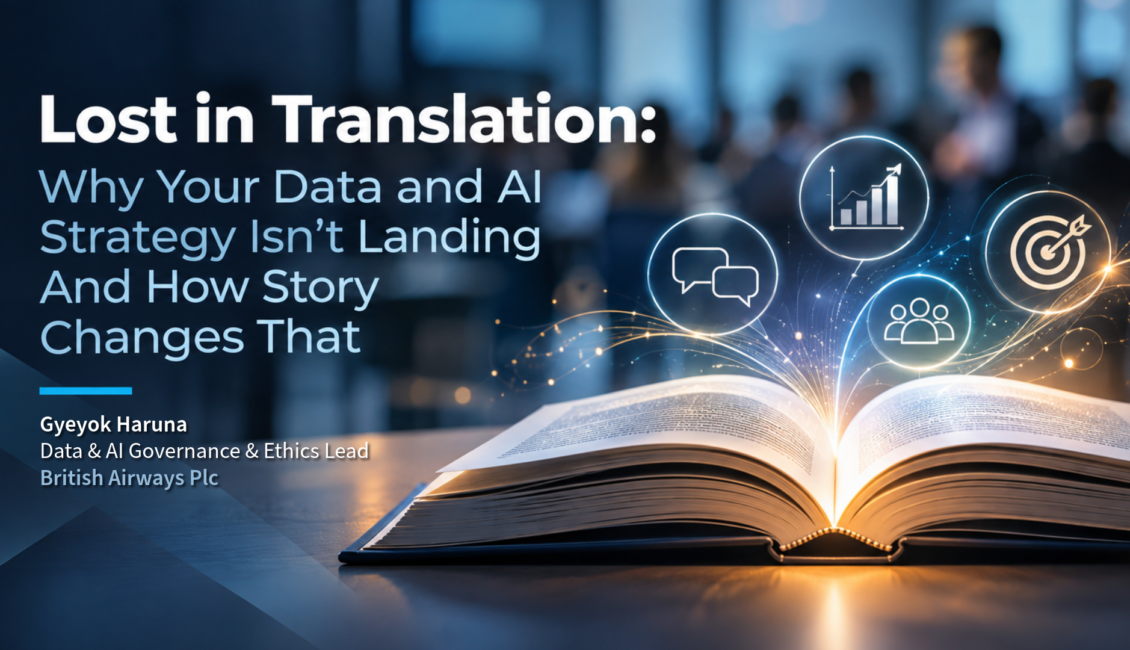
Join Gyeyok Haruna, Data & AI Governance & Ethics Lead at British Airways, at Data & AI Conference Europe 2026 for her session, “Lost in Translation: Why Your Data and AI Strategy Isn’t Landing and How Story Changes That”.
Discover why even the strongest data and AI strategies can struggle to gain traction, and how storytelling can bridge the gap between complex governance frameworks and meaningful organisational change.
Through live demonstrations and audience interaction, Gyeyok will explore how to communicate data and AI strategies in ways that resonate with stakeholders, inspire action and deliver real business impact.
📅 Wednesday 4 November | 09:55–10:25
📍 London | Data & AI Conference Europe 2026