Rethinking Analytics in a Data World: An Interview with Simone Steel
As AI changes the way people access information, ask questions and make decisions, is it also time to rethink what we mean by analytics?
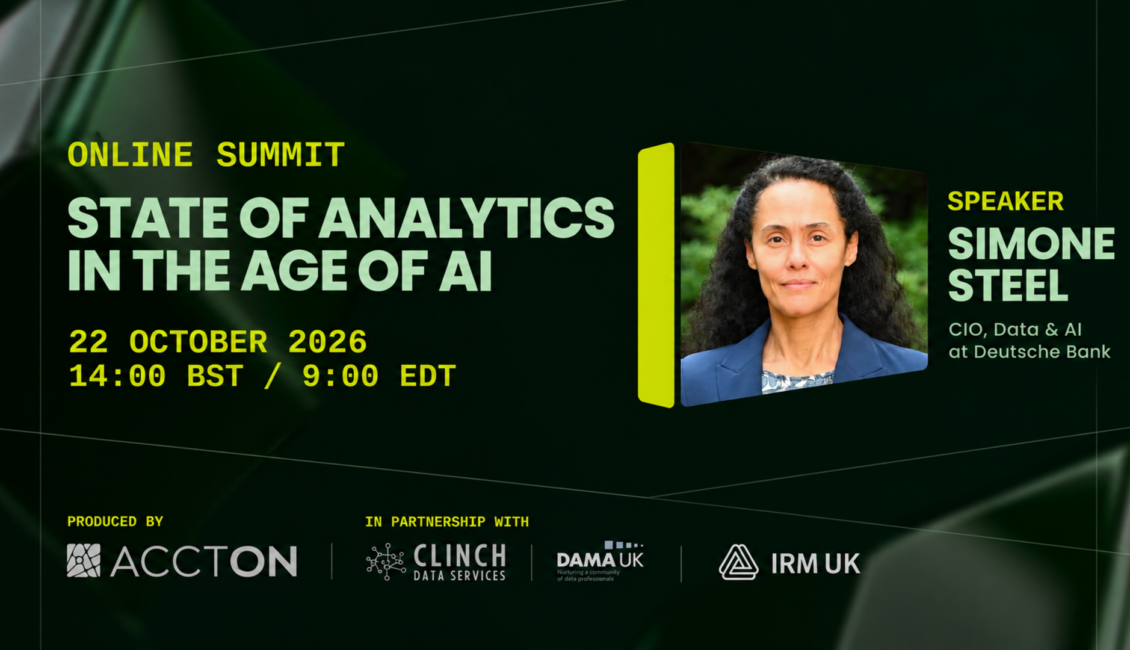
Ahead of The State of Analytics in the Age of AI Virtual Summit on 22 October, Ben Clinch spoke with Simone Steel, Chief Information Officer for Data and AI for Corporate Bank at Deutsche Bank, about how our interaction with data is changing, why the connections between data domains matter, and why organisations may need a common “map” before they can ask better questions of their data.
Simone will explore these ideas further in her keynote, Rethinking Analytics in a Data World: Where Is Your Map?
Simone, could you start by telling us a little about your background?
I’m currently Chief Information Officer for Data and AI for Corporate Bank at Deutsche Bank.
I’ve had a long career in technology and data, from technology companies through to data office and data analytics roles. These days, I’m bringing together architecture, technology and data, hopefully steering us a little more towards the future rather than solving problems of the past.
Why do you think it is particularly important to talk about analytics now?
I think it’s about time we challenged the questions we ask of analytics.
How far has it really moved on since executives first asked for trends, linear predictions, MIS and business intelligence at their fingertips?
We built all of those wonderful dashboards, and I’m sure many of them aren’t actually visited very often anymore.
There are two things happening. One is the questions we ask. The other is how we provide the answers. And I think our whole interaction with data is changing.
For the last ten years or so, we’ve been quite dependent on certain visual disciplines in analytics. But people want to talk. They want answers to questions. They don’t necessarily want to go and find those answers inside a traditional dashboard or report.
So I think this is a good moment to take stock of analytics as a discipline and perhaps step away from some of the technology dependencies to ask: what is the purpose?
What should we be thinking about instead?
One thing I want people to think about is what they actually have in common when they discuss analytics.
What shared understanding do they have of their situation? What do they need to ask in order for the analytics to be useful?
And there is a slightly meta conversation here too. Those of us working in data and analytics sometimes forget that we also need data to do our own jobs. We don’t only provide analytics to other people.
That brings me to what I’m calling situation awareness.
What do you mean by “situation awareness”?
For me, situation awareness is a long way of saying: we need a common map.
If I can see the map of my business or of the problem I’m dealing with, then I can talk in much more human language about what I need to connect.
What data do I need to cross-reference with something else? What is actually available? What do I need to bring together in order to understand the situation?
A lot of the questions analytics could help us answer are not stated particularly well until you understand the situation first.
So we need to come to the same situation, create some common ground and understand what data is truly available.
And I think there are other benefits of having that common map. It isn’t only about the utility of finding the data you need for good analytics. There is also a creative element: being able to explore the landscape, make connections and potentially discover insights into things you didn’t know before.
And why are the connections between different data domains so important?
Because I think intelligence often lies in the intersection of those domains.
The connections between data domains can have more value than the individual domains themselves.
We also have a different environment now. The old internal and external barriers around data flows are becoming much less clear.
And simply because data exists, or because technically you can access it, doesn’t mean it is genuinely available to you.
There may be an ethical dimension. There may be a legal or jurisdictional dimension. Those things are very difficult to take into account unless you have a common map of the situation.
Once you have that, analytics can also become more exploratory. It can take you beyond the questions you already knew you wanted to answer and surface insights into things you didn’t know before.
How do AI assistants and agents change the role of analytics?
We’re hearing a lot now about AI citizens, people having their own assistants and their own agents. They’ll have much more agency and, in some ways, they’ll be making decisions like mini CEOs.
Someone probably isn’t going to come to an analytics team and say, “I need insights on my future sales given this geopolitical crisis.”
They’re going to ask their AI assistant.
So then the question becomes: what is the role of analytics?
Analytics has to be embedded in the terrain, in the landscape of the data.
The loops we’re used to, collecting something, analysing it, distilling it, providing feedback, are shrinking. Those feedback loops are moving towards seconds and minutes.
That changes how we need to think about analytical thinking itself and where it sits across the data estate.
What would you like people to take away from your keynote?
I’d like people to think about what understanding they have of their situation and what they need to ask for their analytics to become more useful.
Do they have a common map? Can they see the connections across the data they have? Do they understand what is genuinely available to them?
And can that help them ask better questions, including questions they might not have known to ask before?
I certainly don’t have all the answers. If I did, I probably wouldn’t be speaking about it, I’d be somewhere solving many more problems!
But I do think there are better ways for us collectively to embed analytical thinking across the data estate, and hopefully the session gives people a different way to think about that.
Simone Steel will deliver the keynote “Rethinking Analytics in a Data World: Where Is Your Map?” at The State of Analytics in the Age of AI Virtual Summit on 22 October.
The Summit brings together senior data and analytics leaders to examine how AI is changing analytics, governance and the existing analytics estate.
Register to join the Summit and hear Simone’s keynote.