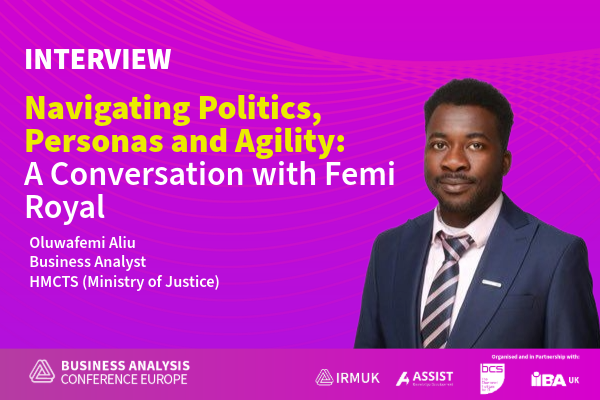
Navigating Politics, Personas and Agility: A Conversation with Femi Royal
Stakeholder influence in Business Analysis has never been more important. While methodologies and frameworks continue to evolve, successful change still depends on understanding the people behind the decisions. In his session, Navigating Politics, Personas & Agility in Public Sector Business Analysis, Femi Royal explores how Business Analysts can navigate complex stakeholder relationships, organisational politics and evolving ways of working to deliver better outcomes.
Drawing on experience from government, digital transformation and international speaking engagements, Femi shares a fresh perspective on understanding stakeholder behaviour and building stronger relationships that drive successful change. Ahead of Business Analysis Conference Europe 2026, we caught up with Femi to discuss why understanding people is becoming one of the most valuable skills a Business Analyst can develop.
1. Your session explores the realities of Business Analysis in the public sector. What inspired you to focus on organisational politics, stakeholder behaviour and agility for BA2026?
For BA2026, I wanted to talk about the thing every BA feels but rarely sees named on a conference agenda: politics. Not politics in the cynical sense, politics in the very ordinary sense of power, relationships and history that shape every decision in a change programme. Working across public sector platforms, I’ve watched brilliant requirements documents go nowhere because nobody had mapped the room they were walking into. Agility gets talked about as a methodology problem. In my experience, it’s a trust problem wearing a methodology costume. I wanted a session that gives BAs a way to read stakeholder behaviour with the same rigour we bring to requirements, and a framework they can use the Monday morning after the conference, not just admire from the audience.
2. Stakeholder management is a challenge in every organisation. What makes it particularly complex within public sector environments?
Four things collide at once, and they rarely collide one at a time. There’s legacy culture, ways of working that predate digital transformation and carry real institutional memory worth understanding, not just replacing. There’s governance running through multiple accountability layers, each with its own definition of ‘done.’ There’s an enormous range of stakeholders, policy leads, delivery contractors, operational teams, all legitimately looking at the same programme from a completely different vantage point. And there’s continuous change: a restructure, a policy shift, a new leader, arriving with no warning and no regard for your delivery plan. Private sector stakeholder management often deals with one of those forces at a time. Public sector deals with all four, simultaneously, on every programme.
3. Without giving too much away, what’s one sign that stakeholder resistance is driven by something deeper than simply a reluctance to change?
Watch for resistance that doesn’t match the stakes. If someone is fighting hard over something genuinely small- a naming convention, a meeting cadence, a minor process step- the fight is rarely about that thing. It’s a signal that something underneath it feels threatened: their expertise, their team’s stability, or a relationship that was already fraying before your programme arrived. The other tell is silence rather than objection. A stakeholder who goes quiet, stops attending, or sends a deputy isn’t necessarily disengaged; often they’re the most dangerous kind of engaged: watching, evaluating, and waiting to see if it’s safe to say what they actually think.
4. Your session introduces personas, behavioural insight and character profiling. Why do you think understanding the people behind the stakeholders is becoming such an important skill for modern Business Analysts?
Because the technical skill gap between BAs is shrinking, and the human skill gap is where the real differentiation now sits. Increasingly, tools can help write a user story or accelerate a workshop. Far fewer can walk into a room, read that a stakeholder’s pushback is really about fear of losing relevance, and adjust their approach in real time. As AI absorbs more of the analytical and documentation work BAs have traditionally owned, the parts of the job that remain distinctly human- creativity, curiosity, courage, communication and compassion- become the actual value a BA brings. Persona work and behavioural insight aren’t soft add-ons to the role. They’re becoming the core of it.
5. Many organisations continue to balance traditional governance with agile ways of working. What advice would you give to Business Analysts trying to build support for new ways of working in established organisations?
Stop trying to win the argument for agile in the abstract; nobody changes their mind because a methodology is objectively better. Instead, find the smallest possible place to demonstrate it, get a real result, and let that result do the persuading. Bring the sceptics in early rather than managing around them; the people asking ‘where’s the evidence’ are often your best quality control, not your biggest obstacle. And respect what the existing governance is actually protecting. Most ‘legacy’ processes exist because something went wrong once and nobody wants it to happen again. Understand what that something was before you try to remove the process built to prevent it.
6. You’ve spoken on international stages across government, innovation and digital transformation. Have you noticed any common lessons about influencing stakeholders that apply regardless of industry or geography?
I’ve spoken at the African Union, the FAO World Food Forum in Rome, and TEDx, alongside my public sector work, and the pattern holds everywhere: technical readiness is never the real bottleneck. People readiness is. Whether it’s a ministry adopting a new case management system or a team piloting a new data platform, the moment of real resistance always traces back to the same handful of human questions — do I trust the people asking me to change, do I understand what this means for me, and was I treated as a participant or a subject in this decision? Geography and sector change the vocabulary. They don’t change the psychology.
7. What are you most looking forward to discussing with attendees at Business Analysis Conference Europe 2026?
The moment in the session where people stop thinking about my case studies and start thinking about their own. I’ll ask the room to picture one stakeholder they’ve quietly written off on a current project, and name which persona they actually are. That’s always the most honest part of any session I run, not the frameworks, but the recognition on people’s faces when they realise the ‘difficult’ stakeholder they’ve been avoiding is actually a pattern they now have a name for, and a next step for.
Femi’s session promises to challenge the way Business Analysts think about stakeholder engagement, showing that successful delivery is often shaped as much by relationships and influence as it is by processes and frameworks. If you’ve ever found yourself navigating competing priorities, hidden agendas or resistance to change, this is a session that will provide plenty of practical insight and food for thought.
Join Femi Royal at Business Analysis Conference Europe 2026 to discover new ways of understanding stakeholder behaviour, building trust and influencing successful change in even the most complex environments.