Delivering Outcomes, Not Outputs: A New Mindset for Business Analysis
Oyetola Florence Idowu, Senior Business Analyst, NHS
In many organisations, project success is often measured by familiar metrics: Was the project delivered on time? Was it delivered within budget? Were all the agreed requirements implemented? While these measures remain important, they tell only part of the story.
The real question organisations should be asking is: Did we create the value we intended to create?
This distinction between outputs and outcomes is becoming increasingly important as organisations invest heavily in digital transformation, process improvement, and strategic change initiatives. Delivering a new system, launching a product, or implementing a process may represent successful delivery, but these outputs alone do not guarantee meaningful business results. This is where Business Analysis can make a difference.
Understanding the Difference
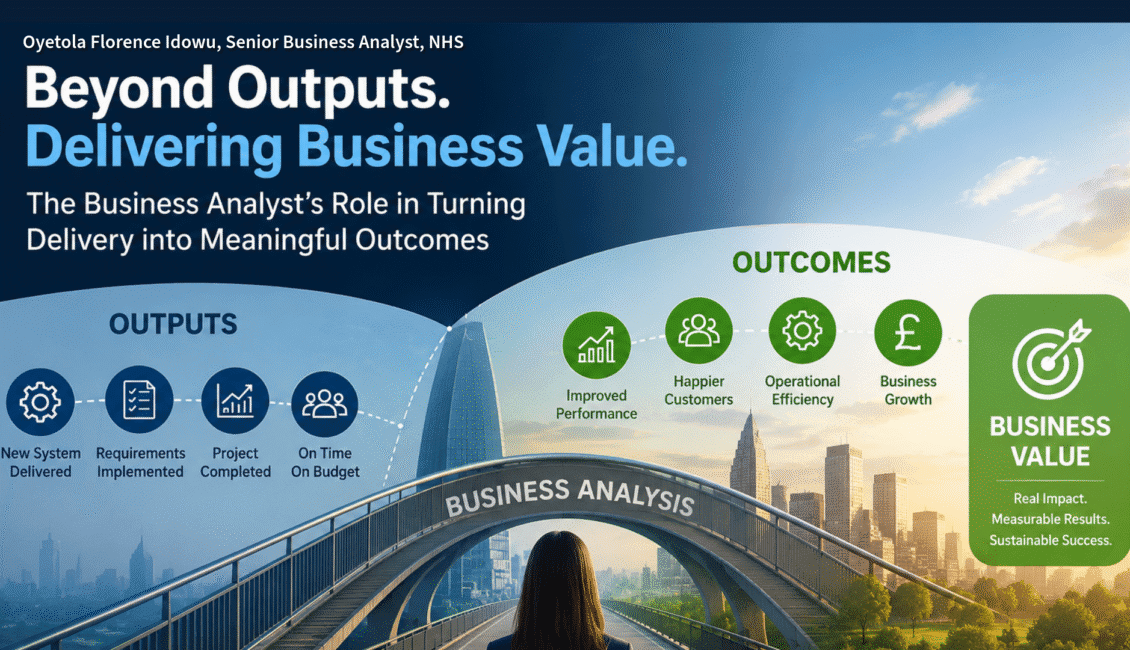
An output is what a project delivers.
An outcome is the benefit or change that delivery creates.
For example:
- Implementing a new customer portal is an output.
- Increasing customer satisfaction and reducing service desk calls are outcomes.
Similarly:
- Deploying a new reporting platform is an output.
- Improving decision-making through better access to information is an outcome.
The challenge is that many organisations focus heavily on outputs because they are easier to measure. Outcomes often take longer to realise and can be more difficult to quantify. Yet outcomes are ultimately what justify investment and demonstrate value.
Why Organisations Struggle to Realise Value
Despite significant investment in change initiatives, many organisations struggle to achieve the benefits outlined in their business cases.
Common reasons include:
- Weak alignment between strategic objectives and project delivery
- Poor stakeholder engagement
- Unclear success measures
- Shifting priorities during implementation
- Limited focus on benefits realisation after go-live
In many cases, teams become so focused on delivering the solution that they lose sight of the problem they were trying to solve. This is where Business Analysts play a critical role.
The Business Analyst as a Value Enabler
The role of the Business Analyst has evolved considerably. Today’s Business Analysts are not simply requirements gatherers or documentation specialists. They are increasingly becoming facilitators of value, helping organisations ensure that change initiatives remain aligned to strategic goals.
By engaging stakeholders, analysing business needs, identifying opportunities, and defining measurable success criteria, Business Analysts help organisations move beyond activity-based delivery towards outcome-based thinking.
They challenge assumptions by asking important questions:
- What business problem are we solving?
- What outcome are we trying to achieve?
- How will we know if we have been successful?
- What metrics will demonstrate value?
- What risks could prevent benefits from being realised?
These questions help keep delivery focused on business impact rather than simply task completion.
Embedding Outcome Thinking Throughout Delivery
Delivering outcomes requires a shift in mindset. Instead of viewing Business Analysis as a phase that happens at the beginning of a project, organisations should see it as a discipline that supports value creation throughout the entire change lifecycle.
This means:
- Aligning requirements with strategic objectives
- Defining measurable benefits early
- Tracking outcomes throughout delivery
- Continuously engaging stakeholders
- Reviewing whether the expected value is being realised
When Business Analysts remain involved beyond implementation, organisations are better positioned to monitor outcomes, identify gaps, and adapt where necessary.
Measuring What Matters
One of the most powerful contributions Business Analysts can make is helping organisations identify meaningful measures of success.
Rather than focusing solely on project metrics such as budget, schedule, or scope, Business Analysts can help define indicators linked directly to business value, including:
- Customer satisfaction improvements
- Reduced operational costs
- Increased productivity
- Improved service quality
- Revenue growth
- Risk reduction
These measures provide a clearer picture of whether change initiatives are delivering the intended outcomes.
Looking Ahead
As organisations face increasing pressure to demonstrate value from their investments, the ability to connect strategy, delivery, and outcomes will become even more important.
Business Analysts are uniquely positioned to bridge this gap. By shifting the focus from outputs to outcomes, they can help organisations move beyond simply delivering projects and towards delivering measurable business value. Ultimately, successful organisations are not those that implement the most solutions.
They are the ones that consistently achieve the outcomes those solutions were designed to create. That is the future of Business Analysis and the mindset that will define the next generation of business value delivery.
References
- Organisations that focus on benefits realisation are more likely to achieve measurable value from change initiatives (APM, n.d.).
- Business Analysis plays a critical role in connecting strategy with successful execution (IIBA, 2024).
- Modern project success is increasingly measured by business outcomes rather than traditional delivery metrics (PMI, 2024).
- Effective management systems are essential for translating strategic objectives into operational results (Harvard Business Review, 2008).
Join Oyetola Florence Idowu at BA2026
As organisations increasingly focus on measurable outcomes, Business Analysts have an opportunity to play a more strategic role in connecting business objectives with successful delivery.
In From Strategy to Delivery: Strengthening Business Analysis for Measurable Value, Oyetola Florence Idowu shares practical frameworks, real-world case studies and proven techniques for aligning strategy, stakeholder engagement and benefits realisation to deliver lasting organisational value.
If you’re looking to strengthen your strategic impact, improve decision-making and demonstrate the true value of Business Analysis, this is a session not to be missed.
From Strategy to Delivery: Strengthening Business Analysis for Measurable Value
📅 Monday 21 September 2026 | 10:40am – 11:25am
📍 Business Analysis Conference Europe 2026, London
Join Oyetola and discover how Business Analysts can bridge the gap between strategy and delivery to drive measurable business value and lasting organisational success.