By Dirk Lerner, Tedamoh – The Data Modeling Hub
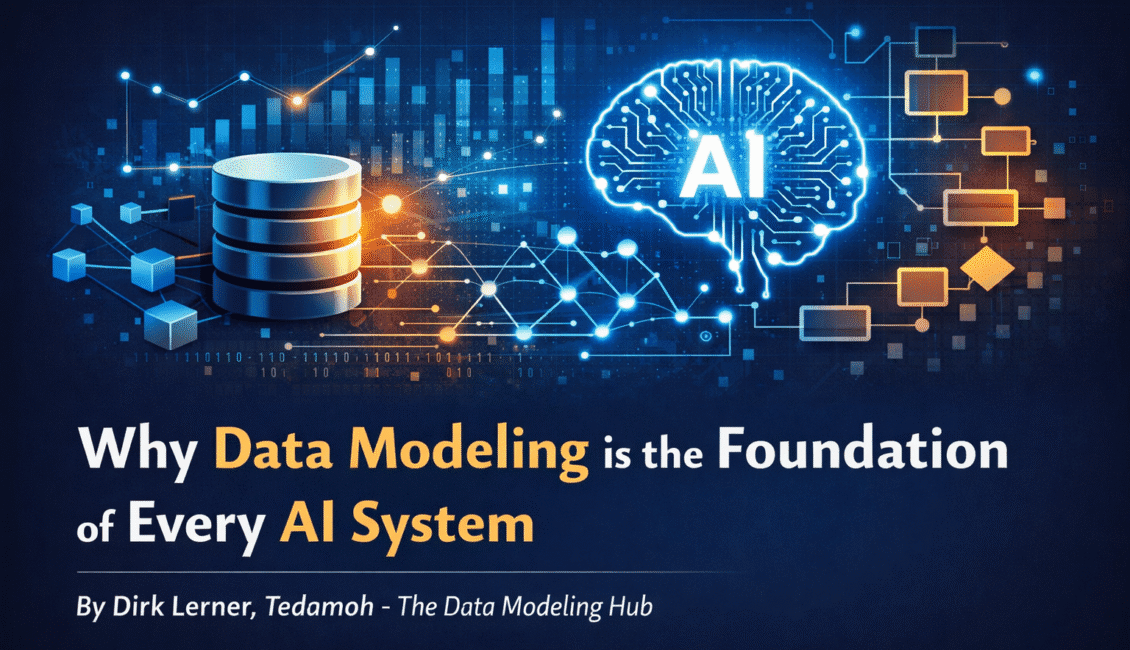
Before an AI system can recognise meaningful patterns, make predictions, or provide recommendations, it needs data with three fundamental characteristics: it must be high quality, clearly structured, and easily accessible. These are precisely the characteristics ensured by professional data modeling.
What makes a well-designed data model? It defines which business objects exist, how they relate to each other, what attributes they have, and what rules govern their use. It ensures that “customer” is always defined according to the same criteria, that timestamps are uniformly formatted, and that relationships between entities remain traceable. Without this foundation, even the most sophisticated algorithms produce random results at best and at worst, they make systematically wrong decisions because they were trained on inconsistent or faulty data.
Customer 360: When Missing Structure Becomes a Business Problem
Let’s take a concrete example from practice: FastChangeCo, a fictional retail company, operates both brick-and-mortar stores and an online shop and wants to offer personalised deals to its customers. The idea sounds simple: an AI analyses purchasing behaviour and makes appropriate product suggestions. In reality, however, this project quickly hits its limits if solid data modeling isn’t in place.
Customer data at FastChangeCo resides in various systems: the loyalty program stores master data and points balances, the online shop manages login information and shopping cart histories, the store systems capture receipts with customer card numbers. Each system has its own logic, its own formats, its own conventions.
Now it gets interesting: Is “Max Mustermann, Hauptstraße 1, 60311 Frankfurt” the same customer as “M. Mustermann, Hauptstr. 1, 60311 Frankfurt”? Or as “Mustermann, Max” with a different house number because the person has since moved?
Without a clear data model that defines how customer data is consolidated, what rules are used to identify duplicates, and how to handle address changes, multiple customer profiles emerge. The result: the same customer receives contradictory offers through different channels, marketing budgets are wasted, vouchers expire unused because they were sent to the wrong profile version. The AI that was supposed to help only amplifies the chaos as it learns from fragmented data and makes correspondingly unreliable predictions.
Only a well-designed data model creates the foundation for a true 360-degree customer view. It defines which attributes uniquely identify a customer, how different data sources are merged, which system serves as the “leading system” for specific information, and what rules resolve conflicts. On this foundation, the AI can actually work – it recognizes purchasing patterns, identifies cross-selling potential, and personalises offers. But it can’t create this foundation itself.
The Problem of Company-Specific Definitions
AI systems excel at recognising patterns in structured data. They can learn from millions of transactions, uncover subtle connections, and make complex predictions. What they cannot do: understand what “customer” means in a specific business context.
Is a customer someone who has already purchased? Or is registration enough? Does a business customer count differently than a private customer? How do you distinguish between the invoice recipient, the delivery recipient, and the user in B2B transactions? These questions have no generic answer – they depend on the business model, the industry, the processes, and often on regulatory requirements.
An insurance company defines “customer” fundamentally differently than an e-commerce company. In insurance, the distinction between policyholder and insured person is essential, while in online retail, the differentiation between registered user, newsletter subscriber, and actual buyer can be crucial. A SaaS company, in turn, thinks in terms of organisations, workspaces, and individual users therefore a completely different structure.
Generic AI models or standard schemas cannot capture these nuances. They work with averages and typical patterns derived from publicly available data or industry-wide conventions. But competitive advantage often lies precisely in the specific definitions and processes that distinguish a company from its competitors. A generic data model would eliminate this differentiation – and with it, part of the uniqueness.
Hope and Reality
The temptation is naturally great: Couldn’t we just feed an AI existing data and have it generate a data model? After all, AI has become so powerful. The sobering answer is: No. AI can recognise patterns, but it doesn’t understand meanings. It can see that the fields “customer_name” and “customer_id” frequently appear together in a database, but it doesn’t know why there are sometimes two different customer IDs for the same name, whether that’s an error or an intentional structure for households.
An AI might suggest that “product” and “article” should be merged because they’re used similarly without understanding that in a company, a product is the abstract marketing unit, while an article is the concrete, stockable SKU. Capturing these semantic differences requires business process understanding and domain knowledge that humans bring, but AI systems do not.
There’s another fundamental problem: Large Language Models (LLMs) are not deterministic. Depending on how clearly, precisely, and specifically the requirements and context are formulated, the most diverse creative variants emerge as results. At first glance, these suggestions may appear correct, but in detail or in the broader context of the company, they can be completely unusable. What’s suggested as a solution today can produce a different result tomorrow with the same query. This inconsistency makes LLMs unsuitable as the sole basis for strategic data modeling decisions.
What’s Next?
This article should not be understood as an exhaustive presentation, but rather as food for thought and a starting point for your own considerations. Development in the field of AI is currently so rapid that much could look quite different in just a few months. However, the principles and fundamental questions described here remain relevant regardless of what new tools or approaches emerge.
Does this mean that AI is completely useless for data modeling? Not at all. The question isn’t whether AI can help, but how it’s used correctly. While AI is not capable of making strategic decisions about business objects and their definitions, it can significantly support data modelers in many other areas.