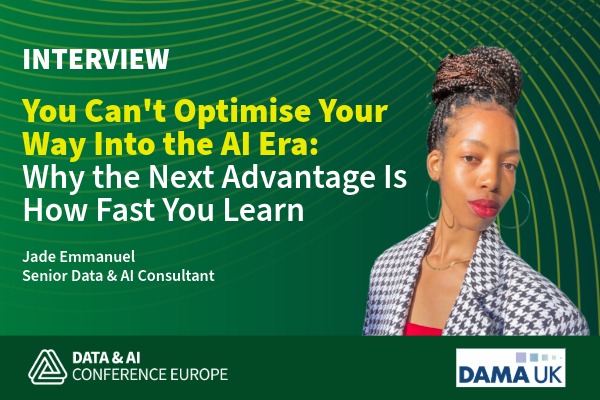
You Can’t Optimise Your Way Into the AI Era: Why the Next Advantage Is How Fast You Learn
Artificial intelligence is transforming organisations at an unprecedented pace, yet many businesses are still struggling to turn AI investment into lasting value. While the focus is often on improving efficiency and automating existing processes, is optimisation alone enough to stay competitive?
At the Data & AI Conference Europe 2026, Jade Emmanuel, Senior Data & AI Consultant, challenges conventional thinking in her session, “You Can’t Optimise Your Way Into the AI Era: Why the Next Advantage Is How Fast You Learn.” She introduces the concept of the discovery-led organisation, exploring how leaders can rethink strategy, decision-making and experimentation to unlock entirely new opportunities with AI.
Ahead of her session, we spoke with Jade about why many AI strategies plateau, what organisations can learn from embracing uncertainty, and how businesses can move beyond incremental improvements to create sustained competitive advantage.
1. Your session argues that organisations can’t optimise their way into the AI era. What do you mean by that?
For decades, organisations have created enormous value by improving what already exists. Better processes, lower costs, greater efficiency. That’s good management, and optimisation will always matter.
The problem is that optimisation has become our default instinct, often before we’ve established whether we’re solving the right problem in the first place.
AI changes the nature of the opportunity. It doesn’t simply allow us to do today’s work more efficiently; it expands what organisations are capable of doing at all. If the first question we ask is, “How can AI improve this process?”, we’ve already constrained our thinking to yesterday’s assumptions.
One conclusion I’ve increasingly come to, from doing work in transformation, is that many organisations don’t have an AI problem. They have an organisational design problem. They’re trying to explore something fundamentally new using systems built to deliver consistency, predictability and control. Those qualities remain important, but when discovery becomes the source of advantage, they are no longer enough on their own.
2. You describe AI as a catalyst for discovery rather than optimisation. Can you explain that idea?
When organisations begin exploring AI, the conversation often starts with automation. Which processes can we speed up? Which tasks can we reduce? Those are sensible questions, but they’re rarely the questions that unlock the greatest value.
The question I find far more useful is, “What becomes possible now that wasn’t possible before?”
That small shift changes everything. It moves the conversation away from replacing existing work and towards creating new capability, new products, new services and entirely new ways of solving problems.
Throughout my own work, whether in large enterprises or fast-moving product environments, the biggest breakthroughs have rarely come from executing the original plan more efficiently. They’ve come from discovering something unexpected early enough to change direction. AI accelerates our ability to do that, but only if organisations are prepared to follow evidence rather than simply defend the roadmap they started with.
3. Your session introduces the concept of a “discovery-led organisation.” What does that look like in practice?
The first thing to make clear on this is that a discovery-led organisation isn’t less disciplined. In many ways, it’s more disciplined.
It doesn’t replace strategy with experimentation or encourage change for its own sake. Instead, it treats learning as something that should be designed into the way the organisation operates.
That means testing assumptions earlier, shortening the distance between insight and decision, and creating mechanisms that allow evidence to influence direction before too much time, money or confidence has accumulated around the wrong idea.
One of the things I’ll explore during the session is a practical model for making that shift. My aim isn’t simply to introduce a new way of thinking, but to show what it looks like in practice, so delegates leave able to apply it within the realities of their own organisations rather than admire it as an interesting concept.
4. Why do you think so many organisations struggle to realise value from their AI investments?
I think many organisations are trying to solve exactly the problem they’ve been taught to solve for decades: reduce uncertainty before making important decisions.
That’s entirely rational. It’s how organisations manage risk.
The difficulty is that AI changes the relationship between uncertainty and value. Some of the most valuable opportunities simply can’t be identified in advance. They only become visible through exploration.
That creates a tension many leaders are feeling today. There is pressure to move quickly, pressure to demonstrate return on investment, and pressure to make the right strategic choices, all while recognising that nobody has a complete playbook for what comes next.
The organisations making the greatest progress aren’t necessarily the ones making the fewest mistakes. They’re the ones that have become exceptionally good at learning from them while they’re still small enough to change course.
5. What practical advice will delegates take away from your session?
I love this question because I think we’ve all experienced the same frustration: attending a genuinely interesting session, filling a notebook with ideas or a camera roll with the session slides, and then never quite finding a way to turn any of them into action.
I don’t want my session to end there.
I’m a big believer that good ideas only become valuable when people can use them, so everyone will leave with something practical. I’ll introduce a simple model for deciding when optimisation is the right approach and when discovery should come first, together with one specific Day One action delegates can put into practice as soon as they’re back at work.
It’s deliberately simple. We often assume meaningful change starts with a major transformation programme, but in my experience it usually starts with a better question, a better conversation, or a different way of framing the problem which acts as that necessary catalyst for change.
If people leave not only thinking differently, but knowing exactly what they’re going to do the next morning, then I’ll feel the session has achieved what it set out to do.
6. Who will benefit most from attending your session?
This session is for anyone responsible for turning AI from an interesting possibility into meaningful organisational value.
Some people will be shaping strategy. Others will be leading data and AI initiatives, building products, designing operating models or supporting organisational change. Different responsibilities, but often the same underlying challenge: making important decisions before anyone can honestly say they know the right answer.
If you’ve ever found yourself wondering, “How am I supposed to lead when nobody really knows?”, then I think you’ll recognise that feeling.
That isn’t a sign you’re behind. It’s the reality of leading through one of the biggest technological shifts we’ve experienced, and I believe there is a much more constructive way to navigate it than simply waiting for certainty to arrive.
7. What’s the one message you hope delegates remember after leaving your session?
I hope people leave with greater confidence in leading through uncertainty.
Not because they’ll have all the answers, but because they’ll see uncertainty differently. We often treat it as something to eliminate before acting. Increasingly, I think it’s something organisations need to be designed to work with.
One of the biggest shifts leaders can make in the AI era is recognising that the real competitive advantage doesn’t come from trying to predict the future more accurately than everyone else. That’s an increasingly difficult bet to place, because it requires you to keep being right in a world that’s changing faster than ever.
The better bet is to build an organisation that learns, adapts and responds faster and better than the world changing around it. Even when your assumptions turn out to be wrong, that organisation keeps getting stronger.
If someone leaves asking better questions, making braver decisions and thinking differently about how their organisation creates value, then I’ll feel the session has achieved exactly what I hoped it would.
Join Jade Emmanuel at Data & AI Conference Europe 2026
AI is changing more than technology. It’s changing how organisations compete, innovate and create value. If you’re looking to move beyond incremental AI adoption and build an organisation that can continuously learn, adapt and discover new opportunities, Jade’s session is one you won’t want to miss.
Join Jade Emmanuel on Tuesday 3 November for “You Can’t Optimise Your Way Into the AI Era: Why the Next Advantage Is How Fast You Learn,” part of the Data & AI Strategy and Value track at Data & AI Conference Europe 2026.
Explore the full agenda, discover more expert speakers and secure your place today.