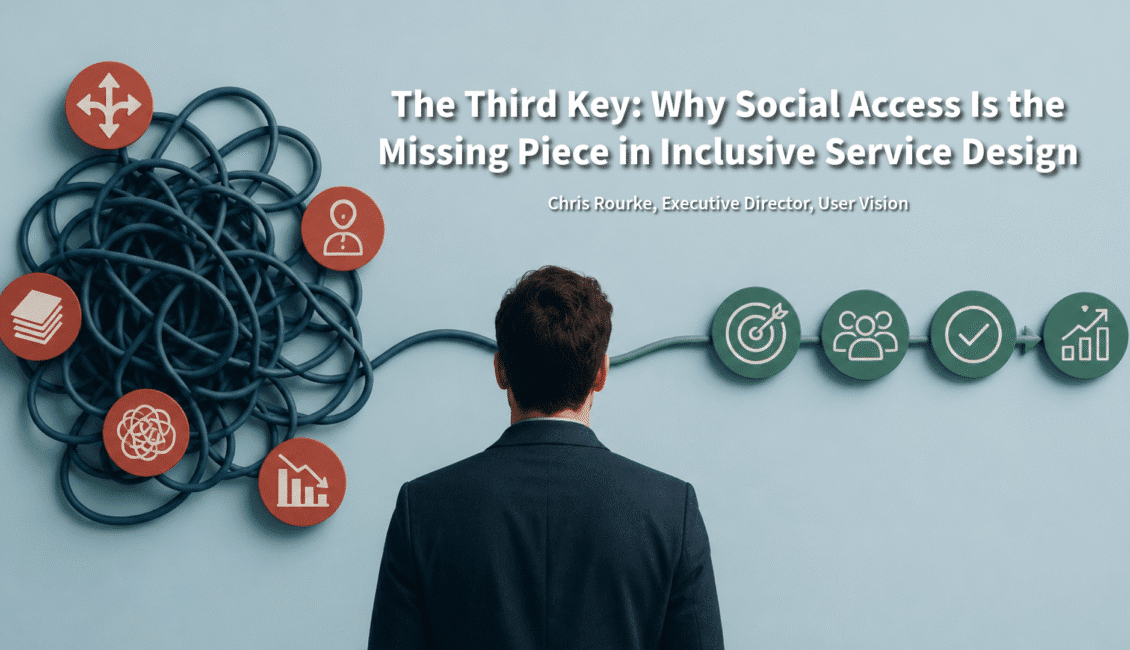
The Third Key: Why Social Access Is the Missing Piece in Inclusive Service Design
Chris Rourke, Executive Director, User Vision
When organisations talk about accessibility, they tend to think in two dimensions.
The first is physical. Ramps, lifts, accessible toilets and step-free entrances are the bricks-and-mortar infrastructure of inclusion increasingly required by law. The second is digital, such as accessible websites, WCAG conformance and screen reader compatibility of the virtual front door through which most service journeys now begin.
Both matter enormously and get significant attention. However, organisations may invest heavily in both and still not provide their disabled customers with a truly seamless end-to-end journey. The reason is usually the third dimension of social access.
The Third Key Most Organisations Miss
Social access is the culture of inclusion, the communication nuances and removal of social friction that determines whether a person feels genuinely welcome. Gavin Neate, founder of WelcoMe, describes social access as the “human software” of a service delivery environment.
Consider a scenario that plays out in many venues. A person with a sensory processing disorder walks into a busy lobby. The building is physically accessible. The organisation’s website is WCAG compliant. But the staff member behind the desk has no awareness of that customer’s specific needs. Unless the customer chooses to declare their disability right there, in public, in a moment that can feel intrusive and deeply vulnerable, the staff member has no way of knowing they need to adapt.
Without that insight, staff may default to a standard service script that leaves the customer feeling overwhelmed and misunderstood. Even though physical access and digital access succeeded, social access failed, and the customer experience, as a whole, failed.
This is not solved in the way most organisations embrace disability awareness or training. Research on the “forgetting curve” shows we lose roughly 70% of new information within 24 hours if it isn’t reinforced. A half-day awareness session delivered six months ago will not be recalled reliably in a high-pressure moment. Awareness needs to be just-in-time, not just-in-case.
Three Keys, One Experience
The framework I explore in my session at Service Design Conference Europe 2026 treats physical access, digital inclusion, and social access as three keys that must all work together. Any one of them can unlock the door to a good experience, but missing any one of them can close that door.
It’s worth considering the commercial reality of getting this wrong. The ‘purple pound’ measures the collective spending power of disabled households in the UK. It is estimated at £274 billion annually. Three-quarters of disabled customers who encounter barriers simply leave, without complaining. They do not give organisations the chance to fix the problem. They find alternatives, or they go without, and they tell others about the experience.
Social access failure is usually invisible to the organisation. A broken ramp gets reported. An inaccessible online checkout flow shows up in support tickets. But a customer who felt unwelcome, misunderstood, or forced into a humiliating moment of public disclosure simply does not come back. The organisation never learns why.
Designing Social Access In
The encouraging news is that social access is designable. It does not have to depend on individual goodwill or a staff member’s memory. It can be built into the operating model of a service, which is precisely what service designers aim to do.
There is a growing ecosystem of tools and approaches to address different parts of the social access challenge. It is useful to think of these in four stages.
The first is signalling: giving disabled customers a way to communicate their needs discreetly in the moment, without a verbal declaration. Schemes like the Hidden Disabilities Sunflower lanyard and the JAM Card (“Just A Minute”) operate at this level. They are low-cost and widely adopted, but their effectiveness depends entirely on staff being trained to recognise and respond to them.
The second is informing: helping disabled people research a venue before they visit, so they can make confident decisions about whether to go at all. Platforms like Sociability, AccessAble, and Euan’s Guide provide verified or community-written accessibility information for thousands of venues. This addresses arrival anxiety, but it still places the burden of research on the disabled person rather than the organisation.
The third stage is preparing, where the organisation is briefed about a customer’s needs before they arrive, rather than waiting for disclosure at the door. WelcoMe is the most developed example of this approach. Disabled visitors share their access and communication requirements in advance via WelcoMe, and staff receive a discreet, real-time briefing before the customer arrives. The burden shifts from the customer to the venue, shop or service provider.
The fourth is sustaining accessibility awareness: building lasting staff awareness through spaced repetition rather than one-off training events. Organisations like Attitude is Everything and Enhance the UK provide training designed to break the forgetting curve, making awareness a regular habit rather than a distant memory from a workshop six months ago.
Most organisations currently operate only at the signalling stage, if at all. The opportunity for service designers is to move their clients further along this spectrum and embed the question of social access into service blueprints from the outset. For every customer touchpoint, ask: Can a disabled customer reach this point? Can they complete the interaction? Will they receive an equivalent quality of service? Those three questions map directly onto physical, digital, and social access. Where the answers are uncertain, that is where the design work needs to happen.
The Universal Dividend
When the service sector gets social access right, the benefits ripple outward. Those staff take that awareness into their communities, their families and friendships. The service sector employs millions of people. Embedding real, sustained inclusion awareness at that scale contributes to a more inclusive society, not just a better business outcome.
True inclusion happens when the physical ramp, an accessible site and a socially aware team work together for every customer who walks through the door.
Chris Rourke is Executive Director, Industry Engagement at User Vision (uservision.co.uk), a UX, service design and digital accessibility consultancy based in Edinburgh. He will be speaking on The 3 Keys to Inclusive and Accessible Service Design at the Service Design Conference Europe 2026. Find out more below: