When the Bell Tolls: Why Transformation Fails the People who Believe in it Most
Karin Höök, Organisational Transformation Advisor, Harwest
I have sat in enough leadership meetings to recognise when the energy starts to fade. The meeting is still moving forward, but the room feels different. People become a little more passive, and the confidence that was there at the start is no longer quite the same.
One of the hardest things to witness in transformation work is not resistance. It is when people genuinely commit to change and still find themselves unable to move.
I worked with a function filled with exceptionally strong people. They had shifted their thinking from delivering output to creating real value. They talked about business impact and meaningful prioritisation with a level of maturity many organisations strive for. They wanted to do it right. They had moved.
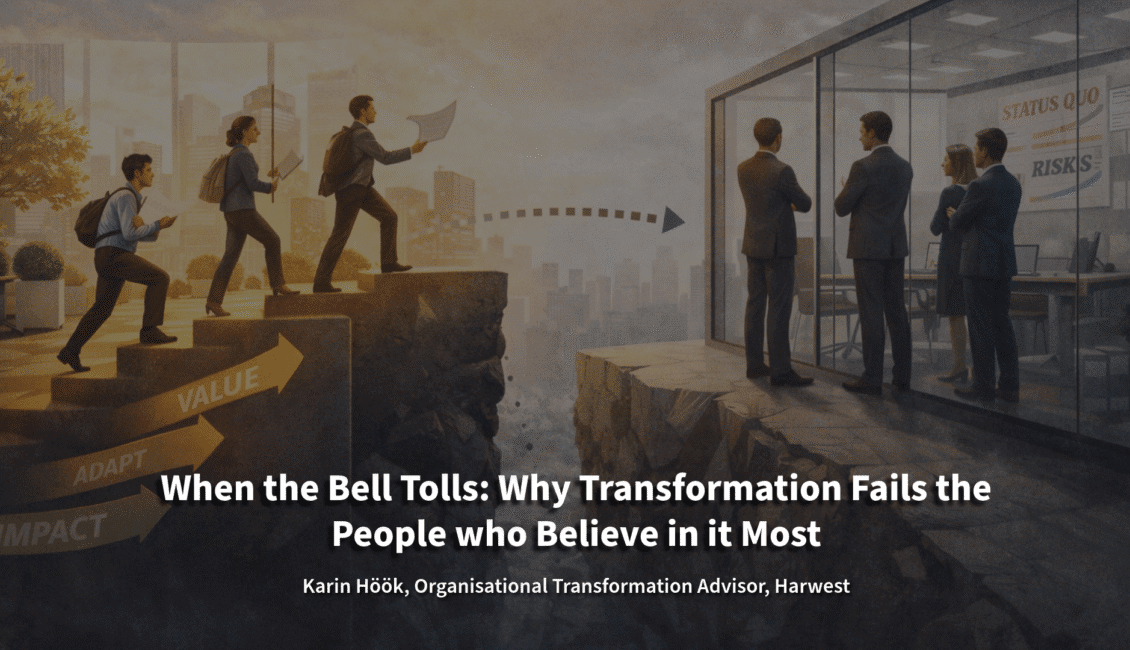
But they were stuck in a system that no one with the power to change it was willing to touch. The same people who had initiated the transformation had not moved themselves. They expected the teams to embrace a new way of thinking while protecting the very structures that made that thinking impossible. A couple of years later, many of the people who had been the strongest drivers were no longer there.
This is not an unusual story. I have seen versions of it more times than I can count, across industries, organisation sizes and transformation approaches. What makes it painful is that it is entirely predictable.
There is a structural phenomenon at play in most large transformations that rarely gets named. People move through change at fundamentally different speeds. Not because some are more capable or more willing than others. But because they work under different conditions, with different incentives, different dependencies and different levels of exposure to what the change actually means in practice. I call this asynchronous change. Some people are deep into adapting new ways of working, while others are still forming their first understanding of why change is needed at all.
It is not necessarily a failure of intent. But it is a failure of design.
Organisations ask their people to change. They rarely change the conditions in which those people work within. The decision paths, the funding models, the prioritisation logic, the reward structures. The things that quietly signal what actually matters.
The people in that function were not stuck because change was impossible. They were stuck because the organisation itself was not ready to change.
This is what I call the Hidden Shift. The moment when insight and knowledge about what the transformation needs next no longer sits at the top, but in the teams doing the work. When the teams who were asked to change have changed, and the real question becomes whether the organisation above them is willing to do the same. It is not a dramatic moment. It rarely announces itself. But it is the point where most transformations either deepen or quietly begin to unravel.
The organisations that navigate it well are not the ones with the best frameworks or the most detailed roadmaps. They are the ones where leadership has been willing to ask the uncomfortable question: Are we changing too?
That question is harder than it sounds. But it is the one that matters most.
I will be exploring this further at the Business Change and Transformation Conference Europe in London this June (08-12 June). If any of this resonates, I hope to see you there.
View the agenda: Agenda
Secure Your Spot: Tickets