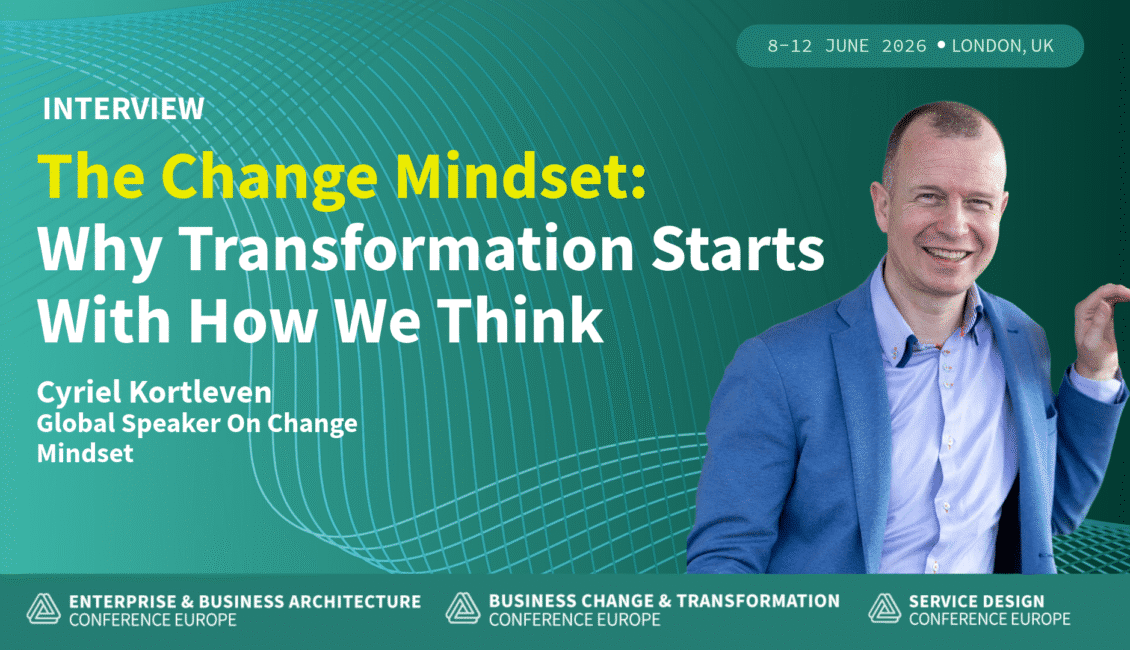
The Change Mindset: Why Transformation Starts With How We Think
Why do so many transformation programmes struggle, even when the strategy, technology, and investment are all in place?
According to global speaker and change mindset expert Cyriel Kortleven, the problem is rarely the plan itself. It is the mindset of the people expected to deliver it.
Ahead of his keynote session, The Change Mindset, at the Enterprise & Business Architecture Conference Europe 2026, co-located with the Business Change & Transformation and Service Design Conferences, we spoke with Cyriel about resistance to change, the fear of failure, and why organisations need to rethink how they approach uncertainty.
Drawing on more than 20 years of experience working with organisations including IKEA, NASA, and Unilever, Cyriel shares practical insights into how leaders can create environments where experimentation, creativity, and behavioural change become possible.
1. Your keynote focuses on developing a “Change Mindset”. Why is mindset becoming such a critical factor in successful transformation today?
Because every change starts – and ends – with a person.
We have the tools. The budgets. The consultants. The roadmaps. And still, most transformations fail. Not because of bad strategy. Because of bad thinking habits.
Here’s what most change programmes miss: they focus entirely on the change itself. The new system. The new structure. The new process. But they forget the one thing that determines whether any of it works – the mindset of the individual.
One person who resists can slow an entire team. One person who embraces uncertainty can shift a whole room.
You can roll out the best transformation programme in the world. If the people inside it are stuck in a “yes, but” mindset, it won’t land.
The good news: you don’t have to wait for a change to work on your mindset. Mindset is a skill you build regardless of what’s changing. And organisations that invest in it don’t just handle one change better. They handle every change better.
That’s the real competitive advantage. Not the plan. The people behind it.
Many organisations struggle with resistance to change. In your experience, what are the root causes of this resistance, and how can leaders address them?
People don’t resist change. They resist uncertainty – and they resist failure.
There’s a difference worth naming. Nobody resists getting a raise, a promotion, or a better chair. What they resist is not knowing what comes next. Not knowing if they’ll still be relevant. Not knowing if they’ll look stupid when they try something new, and it doesn’t work. Two fears. One outcome: people protect what’s familiar.
“We tried this before.” “It’ll never work here.” “We don’t have the budget.”
These are idea killers. They sound reasonable. But underneath them is someone who’s afraid of the unknown, and of being seen to fail.
Leaders who address this don’t fight the resistance. They name it. They say: “I get it. This feels uncertain. And I know nobody wants to look incompetent in front of their colleagues. Let’s talk about that.”
Then they make it safe to try – and safe to fail. Not with a poster. With behaviour. With how they react the first time something goes wrong.
You talk about the importance of suspending judgment. Why is this so difficult in practice, and how can professionals build this habit?
Because our brain is wired to judge. Fast.
Daniel Kahneman described two systems of thinking. System 1 is fast, automatic, instinctive – it reacts before you’ve even decided to think. System 2 is slow, deliberate, rational – it’s the part that can actually weigh a new idea fairly. The problem: System 1 runs the show most of the time. And it hates novelty.
In a fraction of a second, your brain has already decided whether a new idea fits with what it knows; if it doesn’t fit – blocked.
Suspending judgment means manually switching from System 1 to System 2. It’s a skill like a muscle. You build it by practising – deliberately, awkwardly, imperfectly.
One concrete way: the “Yes, and…” rule. Instead of responding to an idea with a “but,” you respond with “yes, and I’d add…” You don’t have to agree. You just have to stay open for three minutes.
Three minutes. That’s all it takes to change the dynamic of a whole meeting.
The idea of “failing fast and often” is widely discussed, but rarely embraced. How can organisations create environments where this is genuinely possible?
Because they celebrate the idea but punish the outcome.
They put “embrace failure” on a poster. Then someone tries something new, it doesn’t work, and suddenly it’s a performance issue. The poster stays. The person learns to stay quiet next time.
You don’t build a failure-friendly culture with slogans. You build it with stories.
Which leader stood up in an all-hands and said: “I tried this, it failed, here’s what I learned”? Which team got recognised – not for their results, but for their experiment? Which mistake became a case study instead of a cautionary tale?
If the only stories you tell are success stories, people learn one thing: don’t fail visibly.
Start telling different stories. The culture will follow.
You introduce the concept of “nano actions”. How can small, practical steps help drive larger behavioural and organisational change?
Because big change is scary. Small change is not.
A nano action is a tiny, concrete behaviour you can do today. Not “be more creative.” But: “At my next meeting, I’ll write down three ideas before I judge any of them.”
Not “build a culture of trust.” But: “This week, I’ll ask one colleague what’s frustrating them – and I’ll just listen.”
The gap between knowing and doing is huge. Nano actions close it.
And here’s what’s interesting: small actions don’t just change behaviour. They change identity. When you do something – even something tiny – you start to see yourself as someone who does that thing. That’s when real change begins.
Don’t wait for the perfect moment. Take the nano action.
How can leaders shift the narrative around change from fear and uncertainty to opportunity and creativity?
First, stop pretending it’s not scary.
Leaders who say “this is exciting!” when their team is terrified lose credibility instantly. People aren’t stupid. They feel what they feel.
The shift starts with honesty. “Yes, this is uncertain. And – here’s what we can control.” Not instead of the fear. Alongside it. Then comes the factor most leaders underestimate: trust.
Not trust as a value on a wall. Trust as a daily behaviour. Let your people make decisions – real ones, not just the easy ones. And when something doesn’t work the first time, don’t step in with a verdict. Step in with support.
“What did you learn? What would you do differently? How can I help?”
That response – in that moment – does more for culture than any change programme. Because it tells people: trying is safe here. And when people feel that, they stop waiting for permission. They start moving.
Make the opportunity concrete. Make the support visible. Make it clear that effort and learning are what you’re measuring – not just outcomes.
Fear shrinks when people feel trusted. The narrative shifts when the trust is real.
For professionals looking to strengthen their own change mindset, what are the first practical steps they can take?
Start by noticing your idea killers.
For one week: every time you catch yourself thinking “yes, but…” – write it down. Don’t judge it. Just notice. You’ll be surprised how often it happens, and how automatic it is.
Then pick one moment where you try the opposite. One meeting. One conversation. One “yes, and…” instead of a “but.”
That’s it. No workshop needed. No transformation programme.
The second step: find your nano action. What’s the smallest possible experiment you can run this week? Not a strategy. An action. Something you can do in five minutes that moves you slightly outside your comfort zone.
Change doesn’t start with organisations. It starts with one person deciding to think differently – for three minutes. Maybe that person is you.
Cyriel Kortleven will explore these ideas and more during his keynote session, The Change Mindset, at the Enterprise & Business Architecture Conference Europe 2026 in London this June.
His session will provide practical tools, fresh perspectives, and actionable techniques to help leaders and teams navigate uncertainty, challenge fixed thinking patterns, and build a stronger culture of experimentation and adaptability.
If you are leading transformation, navigating organisational change, or looking to create a more resilient and creative mindset within your teams, this keynote is not to be missed.
📅 View the agenda:
https://irmuk-architecture-change-design.eventsair.site/
🎟 Secure your place:
https://irmuk.co.uk/tickets-eba-bct-sd-2026/