Designing Connection: Building a Community for People Affected by Pancreatic Cancer
What does meaningful co-creation really look like in service design?
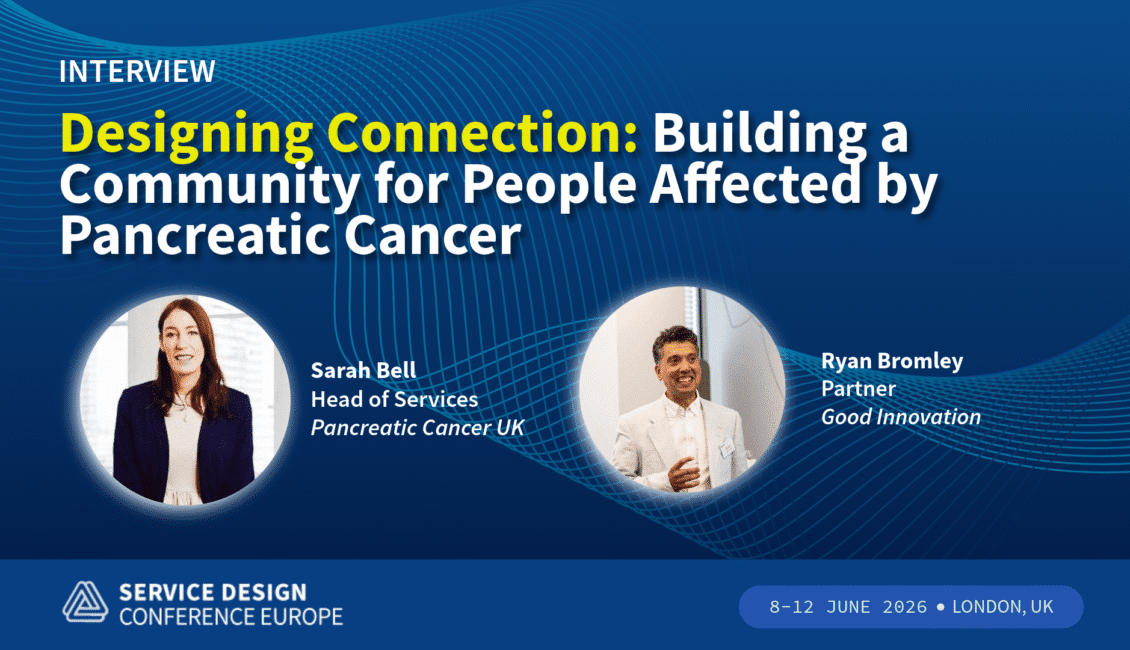
At the Service Design Conference Europe 2026, Sarah Bell from Pancreatic Cancer UK and Ryan Bromley from Good Innovation will share the story behind Circles, a new community-led service designed for people affected by pancreatic cancer.
Built in partnership with people living through the realities of pancreatic cancer, Circles was developed through rapid experimentation, design sprints, and real-world testing using accessible tools like WhatsApp and Facebook. The result is a service that has already had a significant impact, with 100% of surveyed users saying it helped them better manage what they were going through.
Ahead of their session, we spoke with Sarah and Ryan about designing in high-stakes contexts, learning through experimentation, and what happens when lived experience genuinely shapes service design from the very beginning.
1. Pancreatic cancer is one of the toughest areas in healthcare. What made you focus on creating a new service like Circles?
We know that receiving a diagnosis of pancreatic cancer can be devastating and incredibly isolating. We gathered some really rich insights from people with lived experience of pancreatic cancer, and the need to connect with others and be part of a community came out really strongly.
People living with pancreatic cancer need the opportunity to talk honestly about their experiences, to say the things they can’t say to anyone else. And for family and friends, they are often hungry for tips and life hacks from people in their situation. Connecting with others gives the chance to offload about the challenges of caring for someone with pancreatic cancer.
This insight gave us enough to work with to know that we needed to create spaces for people affected by pancreatic cancer to connect in a way that works for them. From here, we designed Circles, a place to share the highs, the lows and everything in between with people who understand, who ‘just get it’.
2. This project was co-created with people affected by pancreatic cancer. How did that shape the direction of the service?
The involvement of people with lived experience had a huge impact on the direction of Circles. People told us that they needed to meet people where they are already at. I think you can have a tendency when designing services to think you have to create something completely new, but actually, hearing directly from people, we heard loud and clear that we needed to make this service easy to access. This led us to WhatsApp and Facebook groups, communities people are already in. In fact, we heard that some people were already connecting in this way. But what if you haven’t been lucky enough to come across others in a similar situation to you through these channels? This is where we come in, as a national charity, facilitating those opportunities for everyone affected by pancreatic cancer.
3. You took a highly experimental approach, from design sprints to rapid prototyping. What did that allow you to do differently?
I loved the experimental approach, and it really enabled us to work at pace but also in a manageable way, starting small and scaling up. Looking back on previous service developments, we would have worked on designing the entire service before launching, which could take anything up to or beyond a year! The approach we took to Circles was refreshing and allowed us to take something to market and test to understand if we’re hitting the right mark, before perfecting absolutely every detail. We carried out user testing within the 3 weeks of our design sprint, so you are getting validation of being on the right track, which feels so important when you’re creating something for people who are facing incredibly difficult times in their lives. Testing small to begin with also allowed us to reduce the risks and be close to the groups we set up to ensure they were having the impact we hoped they would have on people.
4. You used simple tools like WhatsApp to bring the idea to life quickly. What did you learn from building and testing in this way?
WhatsApp enabled us to get the groups up and running quickly, and we could test some of the insights we gathered during our earlier phases of work. When we captured insight from people affected by pancreatic cancer, there was a strong preference for small groups. However, once we had groups set up, the reality was that the groups would require more people in them to ensure conversations keep flowing. We started with 15 people in groups, which proved to be too small, so we were quickly able to expand the groups to 30 people. A simple tool like WhatsApp has enabled us to make tweaks like this along the way.
We set up our initial groups on WhatsApp, starting small-scale, but this also allowed us to learn and then expand on to Facebook. We knew Facebook groups would be larger in size, and they offer a different community feel. By the time we launched the Facebook groups, we had enough confidence in bringing people together in a smaller setting to take the leap into setting up larger groups. We’ve also been able to learn how bringing people together in these two platforms can provide different experiences.
5. The results have been powerful, with users reporting a real impact. What do you think made the service resonate so strongly?
I think we have created the community that people have so desperately needed for a long time, and we have kept it simple. We have enabled the people in this community to be the main focus, rather than us as an organisation. We’re the facilitator in bringing people together, but the impact comes from others in their group. Someone told us during our insight work that ‘the only thing missing for me is connecting with other people, I do feel quite alone, having to be the rock for my family’. Circles can take away that feeling of being alone.
The support, love and information sharing we have witnessed between strangers, connected by a devastating disease, is so powerful. My colleagues and I are blown away daily by the impact this has on people’s lives.
6. What were some of the biggest challenges you faced moving from idea to a live service?
One of the earliest challenges was the sprint itself; by its nature, it requires focus and pace, which means you can’t have everyone involved. Getting the right people in the room, rather than the whole team, was a real discipline.
Data flows were another significant challenge. Setting up the right infrastructure from the outset, how information moves between platforms, how people are onboarded, and how groups are managed required more thinking than we anticipated. Getting that right early mattered because changing it later would have been far more disruptive.
And then there was the question of moderation. Circles brings together people facing incredibly difficult times in their lives, people with a pancreatic cancer diagnosis, family members, and carers. The emotional weight of that means moderation isn’t just a logistical question; it’s a deeply human one. We had to think carefully about what level of team involvement would be needed, knowing that the time required was genuinely unknown at the outset. That uncertainty was something we had to sit with and plan around as best we could, while staying close to the groups so we could respond quickly if needed.
7. What can attendees expect to take away from your session at the Service Design Conference Europe 2026?
First and foremost, a practical and honest account of how co-creation with people with lived experience shaped Circles at every stage, not as a box-ticking exercise, but as the thing that fundamentally changed the direction of the service. It was people affected by pancreatic cancer who told us to meet them where they already were. That insight led us to WhatsApp and Facebook, rather than building something entirely new, and it made all the difference.
You’ll also hear about what it actually looks like to take an experimental approach in a high-stakes context. Starting small, testing quickly, learning and iterating all while working with people facing some of the hardest moments of their lives. We carried out user testing within three weeks of our design sprint, which gave us real validation at pace rather than spending a year perfecting every detail before anyone had seen it.
And we hope you’ll leave inspired by what’s possible when you move at pace and trust the process. The learning by doing approach upskilled our team in design thinking while we were delivering real impact. Those two things don’t have to be in tension. Sometimes the fastest way to learn is to build something, get close to it, and let it teach you.
Sarah Bell and Ryan Bromley will explore these lessons and more during their session, Designing Circles – A New Service for People Affected by Pancreatic Cancer, at the Service Design Conference Europe 2026 in London this June.
Their session will offer a practical and honest look at co-creation, rapid prototyping, and designing services that meet people where they are, while sharing the challenges, decisions, and learnings that shaped the development of Circles.
If you are interested in service design, community-led innovation, or creating meaningful impact through experimentation and collaboration, this is a session not to miss.
📅 View the agenda:
https://irmuk-architecture-change-design.eventsair.site/
🎟 Secure your place:
https://irmuk.co.uk/tickets-eba-bct-sd-2026/