Meaning Without Truth – The Critical Role of MDM in AI-Driven Data Management
Master data management for AI is becoming critical as organisations shift toward knowledge-driven and generative systems. This article explores why meaning alone is not enough without truth.
There is much talk these days about the importance of understanding meaning in data. This focus is not accidental. It is largely a function of the fact that the one thing Generative AI needs more than anything else – rich contextual understanding – is largely missing from our highly structured databases.
Rows and columns are excellent for storage, aggregation, and measurement. They are terrible at conveying nuance, intent, and relationships as humans understand them. If we expect GenAI to unlock the latent value buried inside decades of enterprise data, we must give it more than tables and schemas. We must give it context.
This realization has triggered a justified surge of interest in ontologies, knowledge graphs, and the broader discipline of knowledge management. Many are already calling 2026 the “year of the ontology,” and given the strategic importance of meaning in an AI-driven world, that prediction may well prove accurate.
Let me be clear at the outset: this focus is warranted. Entirely warranted.
But in our collective rush toward meaning, many of us in the data management community are forgetting something equally important. Something foundational.
And that something is truth.
To establish trust in our data, and in the AI systems that increasingly depend on it, we must provide both meaning and truth. One without the other is insufficient.
Over the years, if there is one lesson my career has reinforced repeatedly, it is this: simply dumping large volumes of source data into a warehouse (or a data lake, or a lakehouse) does not, by itself, ensure accuracy. Scale does not create truth. Integration does not guarantee correctness. And abstraction certainly does not absolve us from the need to know whether the data we are using reflects reality.
Meaning without truth is confusion.
You can build the world’s most elegant ontology – one that beautifully models the relationships between customers, products, accounts, and transactions -but if you cannot say with confidence whether Bob Smith and Robert Smith are the same person, your insights will be wrong. And worse, they will be wrong in ways that appear plausible, which is far more dangerous than being obviously broken.
This is not a new problem. It has existed for decades. And for decades, many of us have quietly worked around it, rationalized it, or assumed it would somehow resolve itself downstream.
The importance of addressing both truth and meaning is something my friend Scott Taylor, the “Data Whisperer”, has been emphasizing on conference stages for well over a decade. Much of my thinking on this topic has been shaped by Scott’s framing, and I am grateful for his clarity and consistency on an issue that too many of us have historically treated as secondary.
As an industry, we have built impressive infrastructure to support several dimensions of data quality: consistency, completeness, timeliness, and even conformity to standards. But accuracy – the question of whether the data actually represents the real-world entity it claims to describe – has persistently eluded us. Truth has been the hardest attribute to operationalize, measure, and sustain.
This is where master data management plays a critical, and often misunderstood, role.
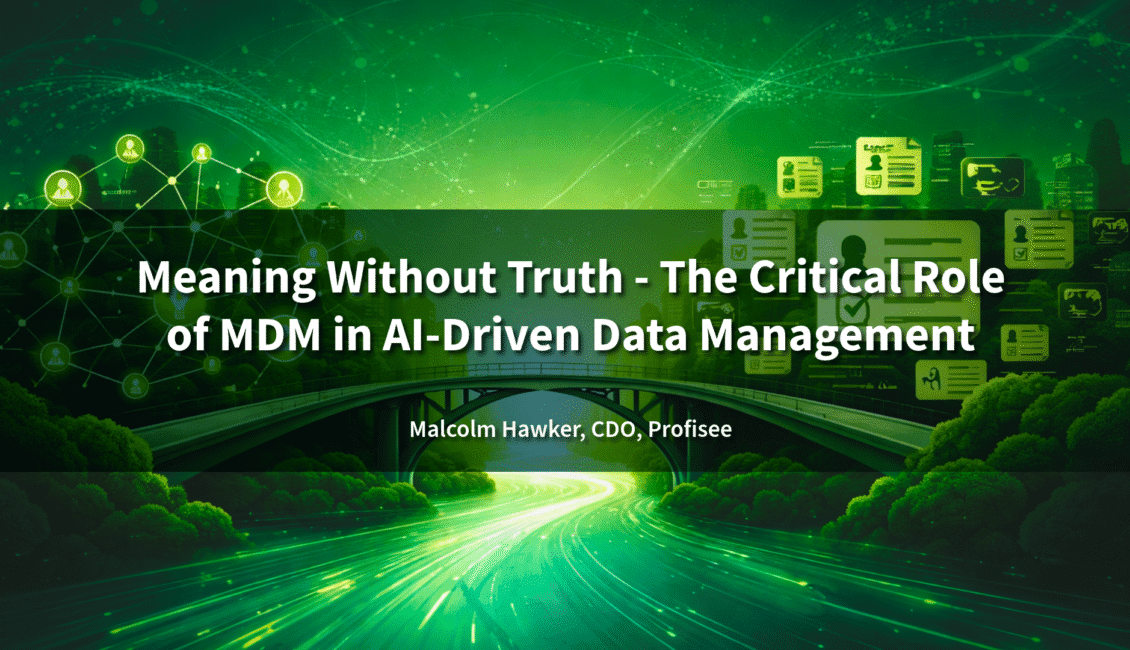
When we enable truth through MDM, we create a necessary bridge between the world of meaning (ontologies, taxonomies, knowledge graphs) and the world of measurement. That bridge is a foundational component in the progression from data to information, and from information to knowledge. If the foundation is weak, the entire structure collapses, no matter how sophisticated the layers built on top of it may appear.
AI is the forcing function that makes this bridge unavoidable.
GenAI demands deep contextual understanding, but it also amplifies the consequences of error. As these systems are embedded into decision-making processes across finance, healthcare, legal, and regulatory domains, the tolerance for ambiguity around truth shrinks dramatically.
Yet far too many voices today are asserting that meaning alone is sufficient. That if you simply implement a knowledge graph, the problem is solved.
Graphs are powerful. They are essential. But they are not sufficient.
Knowledge graphs excel at describing relationships between things. They can tell you that customers relate to accounts, that accounts relate to products, and that products relate to transactions. They can provide semantic clarity across disparate systems, establish consistent definitions, and surface previously hidden relationships. They enable semantic layers that unify concepts like customers, prospects, leads, and accounts under a common conceptual framework.
All of this is incredibly valuable.
But knowledge graphs tend to operate at the object or domain level. And this is where a critical limitation emerges.
Truth does not live at the object level.
Truth lives at the record level.
A “customer” is an object.
John Smith is a customer record.
Accurate, consistent, and explainable identity resolution – the kind provided by master data management – is what allows us to say with confidence that the data associated with John Smith is correct, complete, and trustworthy, regardless of which downstream system is consuming it.
This is precisely where MDM operates. And this is why it remains indispensable.
MDM may not be glamorous. It is rarely described as transformative or disruptive. And yes, it is often difficult. Many organizations have struggled with it over the years, largely because of its deep interdependence with data governance. Governance defines the rules. MDM enforces them. When governance maturity is low, as it is in most organizations, MDM initiatives inevitably suffer.
But difficulty does not negate necessity.
Large language models are not going to magically solve identity resolution in a way that is consistent, explainable, auditable, and configurable. And those characteristics are non-negotiable for high-risk, high stakes use cases in areas like finance, healthcare, and compliance. Probabilistic inference is powerful, but it cannot replace deterministic accountability where trust is mandatory.
Which brings us back to the central point.
MDM remains highly relevant in a world increasingly focused on meaning, because it is the arbiter of truth.
Meaning without truth is confusion.
Truth without meaning is limited.
Ontologies and knowledge graphs solve one half of the equation. Master data management solves the other. Only together do they provide the foundation required to support trustworthy, AI-enabled decision making at scale.
Unsexy or not, that reality isn’t changing.
I am excited to share my perspectives on this critical issue at the IRM Data Governance, AI, and MDM Conference in March of 2026 in the amazing city of London. If you read this blog before that time – and you are able to come to London – it would be great to meet you at the event! Click here for more details: https://irmuk.co.uk/dg-ai-governance-conference/
Also, please follow me on Linkedin if you’re interested in learning more about MDM, or check out the depth of information related to MDM and MDM best practices at the Profisee website, www.profisee.com.
Lastly – I would be thrilled if you checked out my recent book, the Data Hero Playbook, which describes the mindsets that data leaders and practitioners must embrace to succeed in an era of AI: https://a.co/d/09Ctbn5I
CDO, Profisee
February, 2026
To explore these ideas in more depth, join Malcolm Hawker at the Data Governance, AI Governance and Master Data Management Conference Europe, where he will present Mastering Unstructured Data on Monday, 23 March 2026 in London.
In this session, Malcolm will share practical insight on the shift from data management to knowledge management, the governance of unstructured data, and how next-generation semantic layers built on MDM can support an AI-centric future.
If you are looking to move from experimentation to real value with GenAI, this is a session not to miss.
Find out more here: Conference
Purchase your tickets here: Tickets