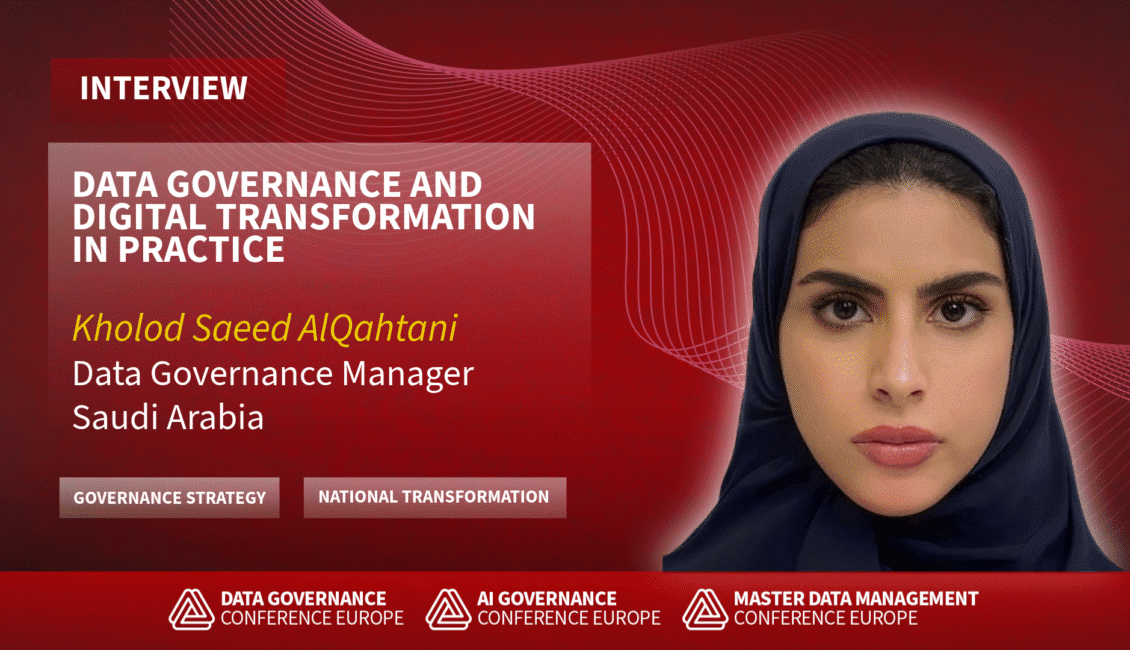
Meet the Speaker: Kholod Saeed AlQahtani on Data Governance and Digital Transformation in Practice
Data governance and digital transformation are increasingly inseparable as organisations look to build trust, scale capability, and align with national strategies. In this Meet the Speaker interview, Kholod Saeed AlQahtani shares insights from Saudi Arabia’s digital transformation journey and the role governance plays in enabling change.
1. Saudi Arabia has made major strides in digital transformation. What role has data governance played in enabling that progress?
Data governance has played a foundational role in enabling Saudi Arabia’s digital transformation by establishing trust, clarity, and accountability across large and complex data ecosystems. As digital initiatives expanded in scope and ambition, governance ensured that data could be reliably used for decision-making, service delivery, and advanced analytics.
Rather than acting as a limiting control, data governance evolved into a strategic capability that supported alignment across stakeholders, enabled scalability, and created the conditions required for sustainable digital and AI-driven transformation.
2. From your experience working on national initiatives, what are the biggest challenges organisations face when trying to implement data governance at scale?
One of the biggest challenges organisations face is the lack of clear data ownership, particularly in environments involving multiple stakeholders and sectors. Fragmented accountability often leads to inconsistent data practices and reduced trust in decision-making.
Another challenge is the perception of data governance as a compliance-driven activity rather than a value-driven enabler. At scale, organizations also struggle with embedding governance into operational workflows and managing cultural change, which are often more complex than defining policies or standards.
3. How can data governance frameworks be designed to support both regulatory compliance and faster, better decision-making?
Effective data governance frameworks should be designed around business and policy decisions rather than regulations alone. When governance clarifies ownership, standardised definitions, and embeds accountability into everyday operations, regulatory compliance becomes a natural outcome rather than the primary objective.
By aligning governance frameworks with strategic goals and operational processes, organisations can meet regulatory requirements while enabling faster, more confident, and better-informed decision-making.
4. What lessons from Saudi Arabia’s digital transformation journey do you think other countries or large organisations can learn from?
One of the most important lessons from Saudi Arabia’s digital transformation journey is the value of a coordinated national governance model. Transformation was supported by a clear strategic vision, central enablement through national data and AI leadership, and structured data governance frameworks, which helped align stakeholders and accelerate maturity across sectors.
Another key lesson is the importance of institutionalising data governance rather than treating it as an isolated initiative. Establishing national-level governance structures, such as the National Data Management Office, enabled consistency, accountability, and trust across the data ecosystem.
Finally, Saudi Arabia’s experience highlights that successful transformation requires governance to evolve alongside ambition. As digital and AI initiatives expanded, governance frameworks were continuously refined to support innovation while maintaining trust, compliance, and responsible data use. This balance between vision, enablement, and regulation is highly transferable to other countries and large organisations operating at scale.
5. How do security, privacy, and data governance need to work together to build trust in large digital ecosystems?
Security, privacy, and data governance must operate as an integrated framework rather than as separate functions. Data governance defines ownership, standards, and accountability; security ensures protection against unauthorised access; and privacy governs responsible, and ethical data use.
When these elements are aligned, organisations can build trust with stakeholders, reduce risk, and confidently scale digital services, analytics, and AI initiatives within complex ecosystems.
6. For leaders starting or accelerating their data governance programs, what is the most important first step to get right?
The most important first step is establishing clear data ownership and accountability. Without defined ownership, governance frameworks cannot be effectively implemented or sustained.
Leaders should focus on identifying responsibility for critical data assets, empowering data owners with clear decision rights, and supporting them through executive sponsorship, clear standards, and organisational alignment.
To explore these ideas in more depth, join Kholod Saeed AlQahtani at the Data Governance, AI Governance and Master Data Management Conference Europe, where she will present Accelerating Digital Transformation through Data Governance: Lessons from Saudi Arabia on Monday, 23 March 2026 in London.
In this session, Kholod will share real-world insights from Saudi Arabia’s national digital transformation journey, exploring how data governance can act as a strategic enabler of trust, better decision-making, and regulatory alignment. Attendees will gain practical lessons on designing governance frameworks that support large-scale transformation while balancing security, compliance, and organisational alignment.
If you are interested in how data governance can drive meaningful digital transformation at scale, this is a session not to miss.
Find out more here: Conference
Purchase your tickets here: Tickets